



新闻中心
最真实的客户反馈,高高度信息丰富的技术支持视频和我们的最新更新!
最真实的客户反馈,高高度信息丰富的技术支持视频和我们的最新更新!

浏览: 136

发布时间:2026-08-19
When creating a digital globe, planet, art installation, or immersive centerpiece, there are usually two ways to display content on a spherical surface: an LED sphere display or a projection mapping system.
Both technologies can create impressive visual effects, but they work in very different ways. An LED sphere produces light directly from LED pixels, while projection mapping sends light from external projectors onto a physical sphere.
So, LED sphere vs projection system: which one should you choose?
The answer depends on the installation environment, viewing angle, brightness, project duration, content, and maintenance requirements.
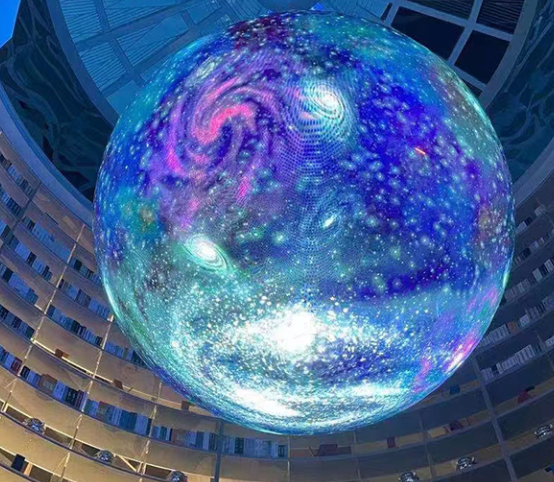
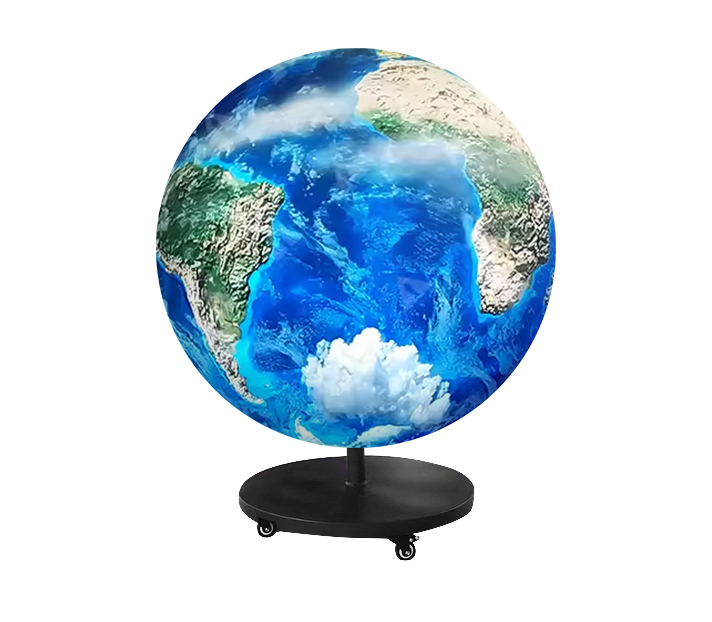
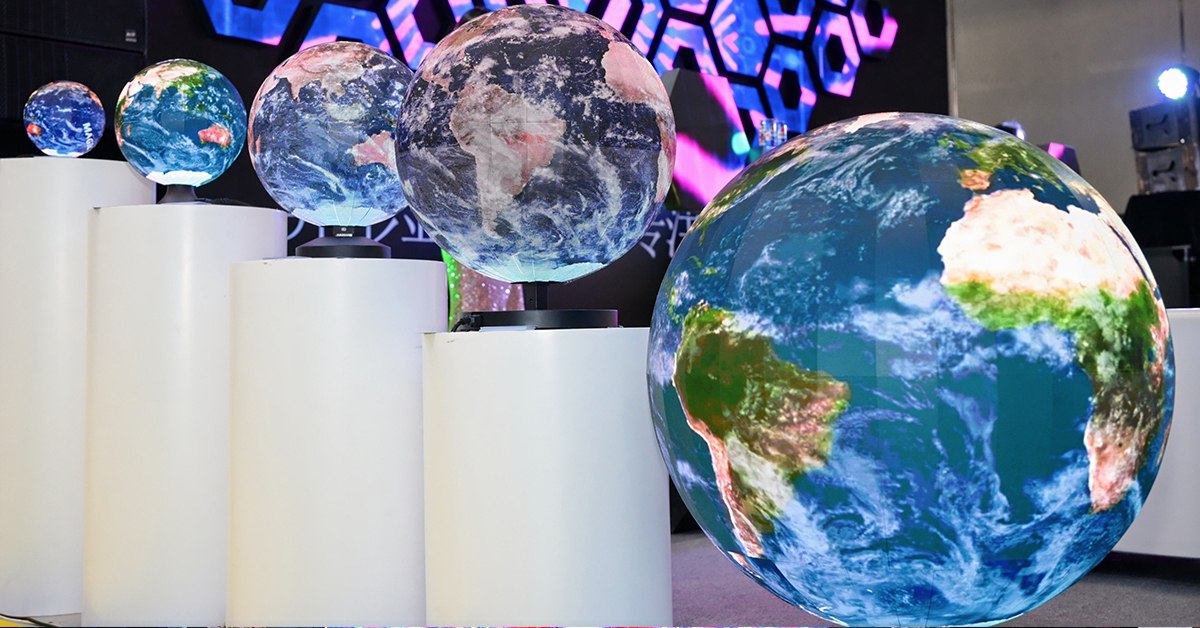
An LED sphere display is a digital display built in a three-dimensional spherical structure. Instead of projecting an image onto the sphere, the LED pixels are part of the display itself.
The screen can show videos, animations, logos, maps, planets, advertising content, and other creative visuals across the curved surface.
Unlike a traditional flat LED wall, a spherical LED display can be viewed from different directions. This makes it especially useful as a centerpiece in shopping malls, museums, science centers, exhibitions, airports, showrooms, and entertainment venues.
Depending on the project, different pixel pitches and sphere sizes can be selected according to the viewing distance and required image detail.
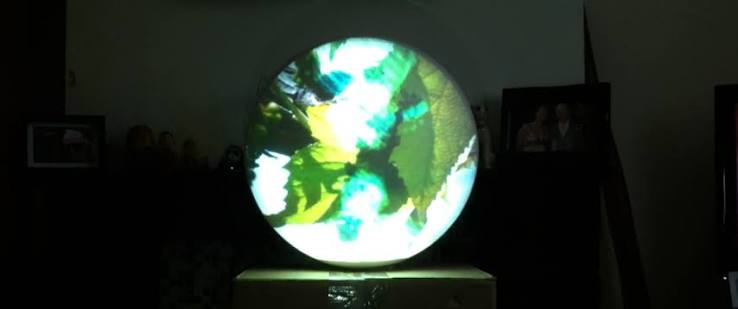
A sphere projection system normally uses one or several projectors to cast images onto a physical spherical object.
Projection mapping software adjusts the original image to match the shape and position of the sphere. For more complex installations, several projectors may work together to cover a larger part of the surface.
This technology is popular for temporary exhibitions, stage performances, digital art, museums, and immersive installations.
The biggest advantage is flexibility. The physical object does not need to contain LED modules, so projection can transform an existing sculpture, building surface, stage prop, or sphere into part of a visual experience.
However, projectors require a suitable installation environment. Projector position, ambient light, viewing direction, shadows, geometric correction, and calibration can all affect the final result.
| Feature | LED Sphere Display | Projection Mapping |
|---|---|---|
| Light source | Self-emitting LED pixels | External projector |
| Ambient light | Strong performance | More sensitive to ambient light |
| 360° viewing | Well suited | Requires careful projector arrangement |
| Shadows | No projection shadows | Shadows may occur |
| Image mapping | LED pixel mapping | Geometric mapping and calibration |
| Installation | Physical LED structure | Projector + sphere + mounting |
| Permanent use | Excellent | Depends on environment |
| Temporary art projects | Good | Excellent |
| Daytime use | Strong | More challenging |
| Existing surfaces | Requires LED structure | Excellent flexibility |
Instead of thinking only in terms of “bright vs dark,” it is more useful to imagine how each technology behaves in a real space.
An LED sphere is like a self-contained light object. It does not depend on the environment to “receive” brightness—it generates it. This means the sphere can stay visually stable even when the surrounding space changes, such as shifting exhibition lighting, daylight from glass buildings, or mixed lighting in commercial venues.
Projection mapping behaves more like a dialogue with the environment. The final image is the result of interaction between projector output, surface reflection, and ambient light conditions. When the environment is controlled, this interaction can feel very cinematic. But when lighting conditions are unpredictable, the visual consistency may fluctuate.
So the real difference is not just brightness—it is control vs dependency on environment.
A spherical LED display creates a “continuous visual object.” Content is not tied to a single front-facing direction, so the sphere itself becomes the center of attention. This makes it especially effective in open spaces where audiences naturally circulate around the installation.
Projection systems, on the other hand, are closer to a “designed viewpoint experience.” Even when multiple projectors are used, the system is still built around coverage planning—deciding how the image wraps, overlaps, and aligns across the surface.
This leads to a subtle but important difference:
LED sphere → content is inherently omnidirectional
Projection → omnidirectional effect is engineered
In practice, this means LED spheres feel more “object-like,” while projection spheres often feel more like “illuminated surfaces.”
Both systems rely on precision, but the nature of that precision is different.
Projection mapping requires spatial alignment between light source, surface geometry, and viewer perspective. Any movement in the environment—people walking through beams, slight projector shifts, or surface irregularities—can influence the final image behavior. This is why projection installations often feel like “living systems” that need tuning over time.
LED spheres replace optical alignment with structural alignment. Once the physical modules are correctly assembled and calibrated, the image is generated directly at pixel level. This removes many environmental variables, but introduces another layer of engineering focus: mechanical accuracy and signal consistency across a curved structure.
In simple terms:
Projection = optical precision in space
LED sphere = structural precision in hardware
Both require calibration, but they “solve” different types of complexity.
Installation requirements can vary significantly.
An LED sphere requires a supporting structure, LED modules, power supplies, receiving cards, controllers, wiring, and suitable access for maintenance.
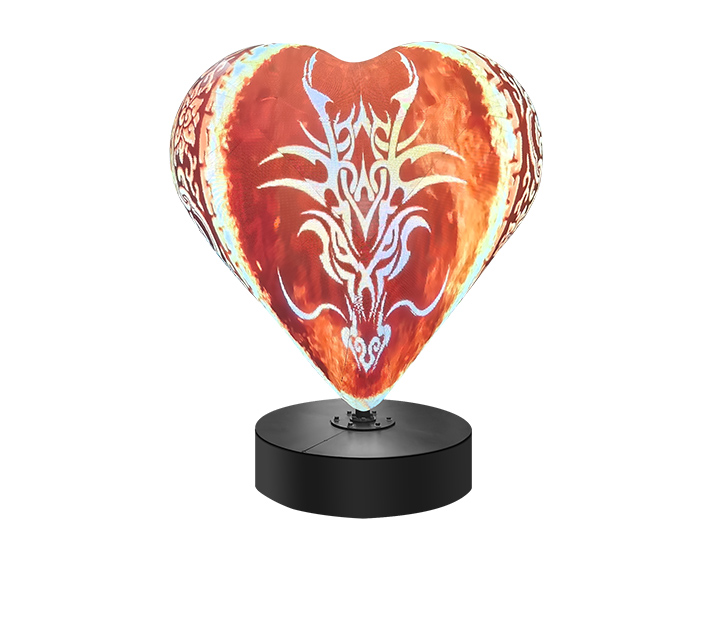
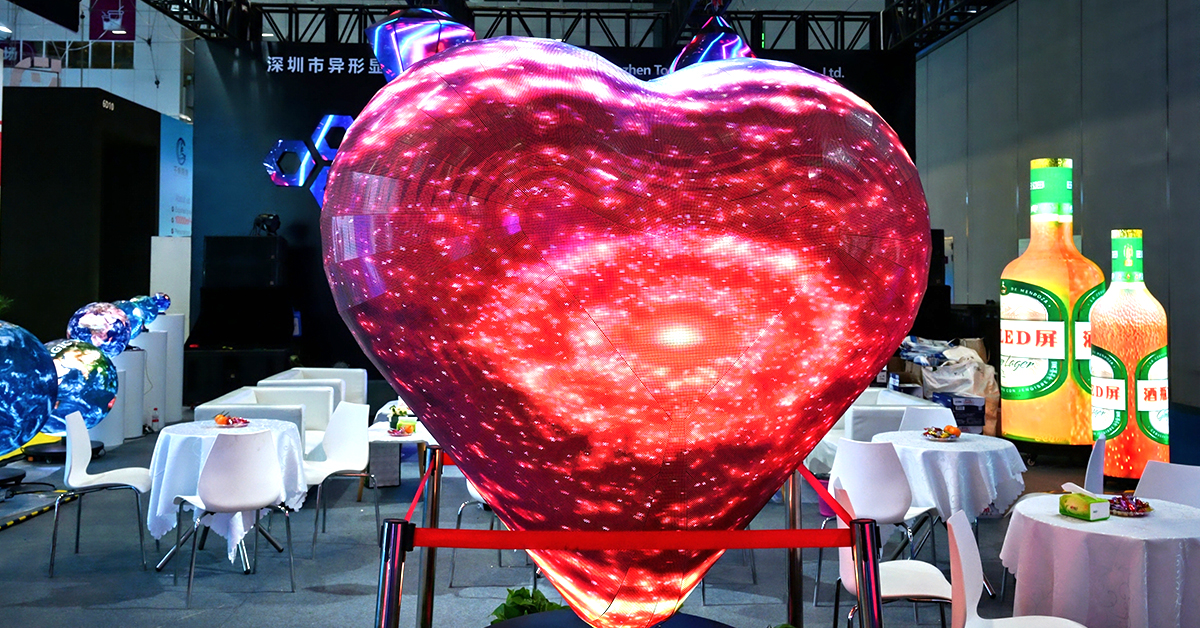
TOOSEN also provides custom-shaped LED display solutions for spherical, curved, cylindrical, polygonal, and other creative structures.
Projection mapping requires different equipment, including projectors, mounting structures, signal equipment, mapping software, and a physical projection surface.
Projector position is especially important. If equipment is moved after calibration, the image may need to be adjusted again.
For long-term installations, buyers should consider maintenance access and operating stability rather than looking only at initial installation cost.
It is difficult to say that LED or projection is always cheaper.
Project cost depends on sphere diameter, resolution, brightness, installation height, number of projectors, LED pixel pitch, supporting structure, control system, and project duration.
Projection can be attractive for temporary installations because the existing physical surface may be reused.
For permanent commercial installations operating for many hours every day, an LED sphere may provide better long-term value because the display is designed as a complete digital structure.
Instead of comparing only purchase prices, calculate the total cost of ownership, including installation, calibration, maintenance, replacement parts, power consumption, and expected operating time.
Choose an LED sphere display when:
The display needs to operate for long periods.
Ambient lighting cannot be fully controlled.
Visitors need to view content from multiple directions.
360-degree visibility is important.
The installation is permanent or semi-permanent.
Advertising, branding, or frequently updated digital content is the main purpose.
Choose projection mapping when:
The installation is temporary.
The existing physical object must remain unchanged.
Ambient lighting can be controlled.
Artistic transformation is more important than screen brightness.
The project involves very large or unusual existing surfaces.
Yes.
LED and projection do not always need to compete.
For example, an LED sphere can become the central visual object while projection mapping covers the surrounding walls or floor.
The LED sphere provides a bright 360-degree focal point, while projection expands the visual content beyond the sphere.
This hybrid approach can work especially well in museums, science centers, brand exhibitions, digital art spaces, and immersive experience centers.
TOOSEN develops and manufactures creative LED solutions for indoor and outdoor applications, including spherical, curved, flexible, and other custom-shaped LED displays.
Its flexible LED display technology can also be used for curved and irregular structures where conventional flat LED cabinets are unsuitable.
For spherical and custom LED projects, size, pixel pitch, brightness, installation method, control system, and structure can be selected according to the actual application.
TOOSEN also provides OEM/ODM services, technical support, installation guidance, and after-sales assistance for international projects.
There is no single winner in the LED sphere vs projection system comparison.
Projection mapping is highly flexible for temporary art installations and projects where an existing physical surface needs to become part of the visual experience.
An LED sphere display, on the other hand, is better suited to applications that require strong brightness, long operating hours, stable 360-degree visibility, and permanent digital content.
The best choice starts with one question:
Do you want to project an experience onto a sphere, or do you want the sphere itself to become the digital display?
For permanent commercial installations, exhibitions, museums, shopping malls, and branded visual landmarks, a spherical LED display can provide a powerful combination of visibility, creativity, and long-term usability.
 +86 18688923792
  andy@tosled.com


