

Industry news


View: 487

Release time:2026-04-23
As summer approaches, temperatures continue to rise—and so do the environmental risks for LED display systems. High heat, humidity, and frequent thunderstorms can all affect performance and lifespan. Therefore, proper cooling and protection strategies are essential to keep LED screens running safely and efficiently throughout the hot season.
Indoor and outdoor LED displays face different challenges. Indoor systems mainly deal with heat buildup, while outdoor installations must also withstand storms, lightning, and strong winds. Let’s break down the key protection measures for both environments.
Indoor LED displays are less exposed to weather conditions, but heat accumulation and ventilation issues can still cause serious problems if not managed properly.
For LED displays under 20 square meters, air conditioning is generally unnecessary. Instead, natural ventilation or small fans are usually sufficient.
In practice, two small axial fans (around 500mm in diameter) can effectively maintain airflow. In many southern regions with relatively stable indoor temperatures, this setup already provides adequate cooling.
However, the installation environment matters. Always evaluate the space before deciding on airflow solutions.
When the LED display exceeds 20 square meters, ventilation must be upgraded according to screen size and heat output.
In these cases, you should:
Install appropriately sized industrial fans based on total screen area
Ensure protective mesh covers are installed inside the structure to prevent foreign objects from entering and causing safety hazards during maintenance
Add external aluminum louver vents on the enclosure to improve air circulation while maintaining dust and water resistance
As a result, airflow becomes more stable, and the system operates at a safer temperature range.
Outdoor LED displays operate in much harsher environments. In addition to high temperatures, they must withstand rainstorms, typhoons, lightning strikes, and strong UV exposure. Therefore, protection strategies must be more comprehensive and system-focused.
Outdoor LED screens generate significant heat due to their large size and high power consumption. At the same time, external temperatures in summer further increase thermal stress.
To prevent overheating issues such as circuit failure or short circuits, you should take the following measures:
Ensure LED circuit boards are manufactured with stable, high-quality components
Use hollow or ventilated cabinet structures to enhance passive heat dissipation
Maintain proper airflow around the installation area during system design and site planning
Add active cooling systems such as internal air conditioners or industrial fans when necessary
In short, effective heat management directly determines system stability and lifespan.
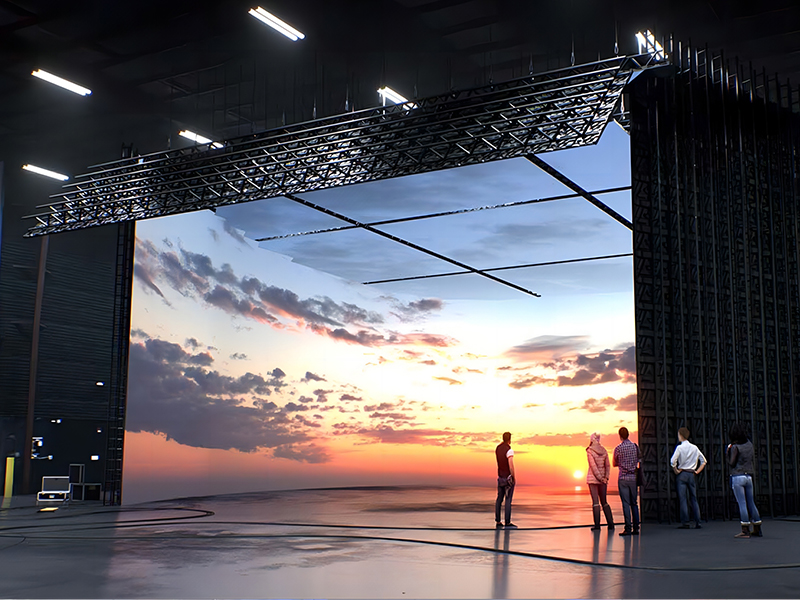
Summer thunderstorms introduce one of the biggest risks for outdoor LED systems: lightning damage. Because LED displays integrate highly sensitive electronic components, they are vulnerable to both direct strikes and induced surges.
To minimize risk, a layered protection strategy is required.
Install lightning rods on the supporting steel structure of the LED display. This helps redirect direct strikes safely into the ground.
Connect the steel structure and LED cabinet to ensure equipotential bonding. In addition:
Establish a proper grounding system
Keep grounding resistance below 10 ohms whenever possible
If resistance is too high, install an additional artificial grounding grid
Ensure all surge protection devices are properly grounded
This step is essential for system-wide electrical safety.
To protect against induced lightning currents on power lines, install surge protection devices (SPDs):
Use single-phase or three-phase power surge protectors
Ensure copper conductor cross-section is not less than 10 mm² for phase lines
Ground wire cross-section should not be less than 16 mm²
These measures help prevent high-energy surges from damaging internal circuits.
Lightning can also enter through data transmission lines. Therefore, signal protection is equally important.
Install appropriate signal surge protectors based on interface type
Ethernet cables require network SPDs
Serial communication ports require DB9 or equivalent protection modules
Grounding wire cross-section should not be less than 1.5 mm²
As a result, both control systems and display modules remain protected from transient voltage spikes.
Summer presents serious operational challenges for both indoor and outdoor LED displays. However, with the right cooling design, ventilation strategy, and multi-layer lightning protection system, these risks can be effectively controlled.
Indoor displays rely mainly on smart airflow management, while outdoor systems require a full structural and electrical protection strategy. By implementing these measures, businesses can ensure stable performance, reduce maintenance risks, and extend the overall lifespan of their LED display systems—even in the most extreme summer conditions.
 +86 18688923792
  andy@tosled.com