



Industry news


View: 917

Release time:2026-05-28
The viewing angle of an LED display refers to the angle range within which viewers can still see clear and acceptable image brightness.
More specifically, the viewing angle is defined as:
The angle between two viewing directions where the screen brightness drops to 50% of the brightness measured directly in front of the display surface.
In LED display technology, engineers also call this the half-power angle or half-brightness angle.
To understand viewing angle correctly, several important concepts must be clarified.
The normal direction refers to the line perpendicular to the display surface.
In simple terms, this means the direct front-facing position of the LED screen.
At this position, the display produces its maximum brightness.
As the viewing position moves away from the center, screen brightness gradually decreases.
When the brightness drops to 50% of the front-facing brightness, the corresponding angle becomes the viewing angle boundary.
The horizontal viewing angle measures the visible range from left to right.
The vertical viewing angle measures the visible range from top to bottom.
Manufacturers usually follow a standardized testing process to measure viewing angles accurately.
The screen first displays:
Maximum brightness
Maximum grayscale level
A single primary color (typically red, green, or blue)
This ensures consistent measurement conditions.
Technicians measure the brightness directly in front of the screen.
This value is commonly labeled:
[
B_F
]
where:
(B_F) = brightness in the normal direction
Next, the measurement equipment rotates horizontally or vertically away from the center.
Technicians continuously monitor brightness changes during rotation.
The system identifies two symmetrical positions where the brightness becomes:
B = frac{B_F}{2}
These two positions define the visible viewing boundaries.
The total viewing angle equals the sum of the two symmetrical angles relative to the normal direction.
For example:
Left side: 70°
Right side: 70°
Then the total horizontal viewing angle becomes:
70^circ + 70^circ = 140^circ
Many people misunderstand LED display viewing angle.
The viewing angle is not:
The angle between the viewer and the screen surface
Instead, it is:
The angle between two symmetrical viewing directions where brightness drops to 50%
This distinction is very important in LED optical design.
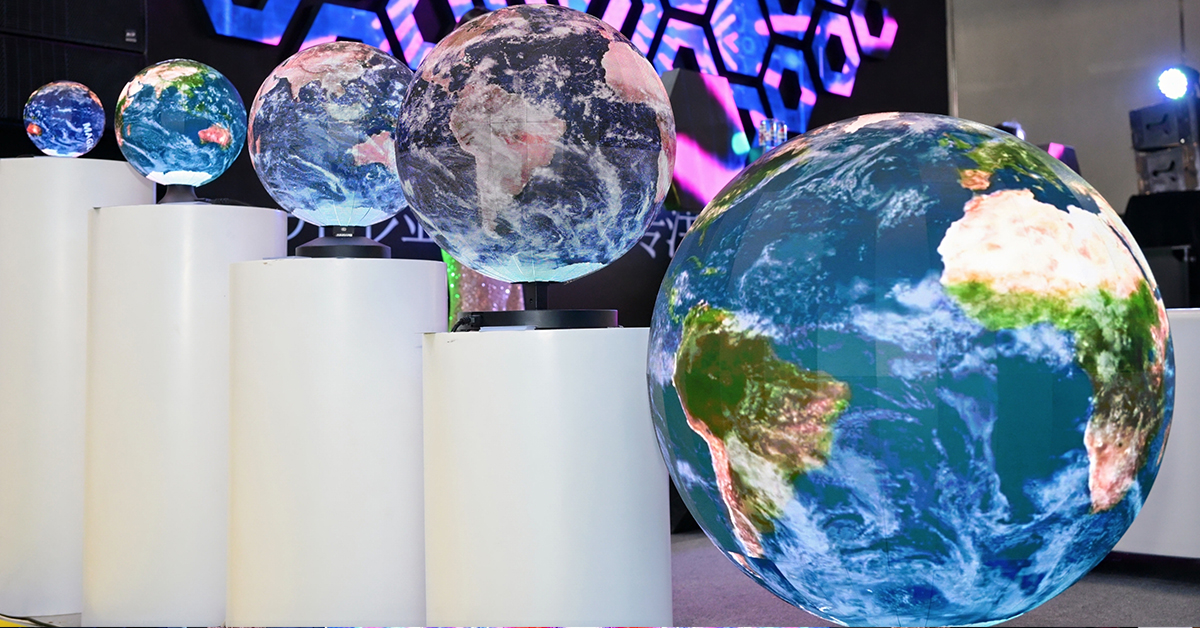
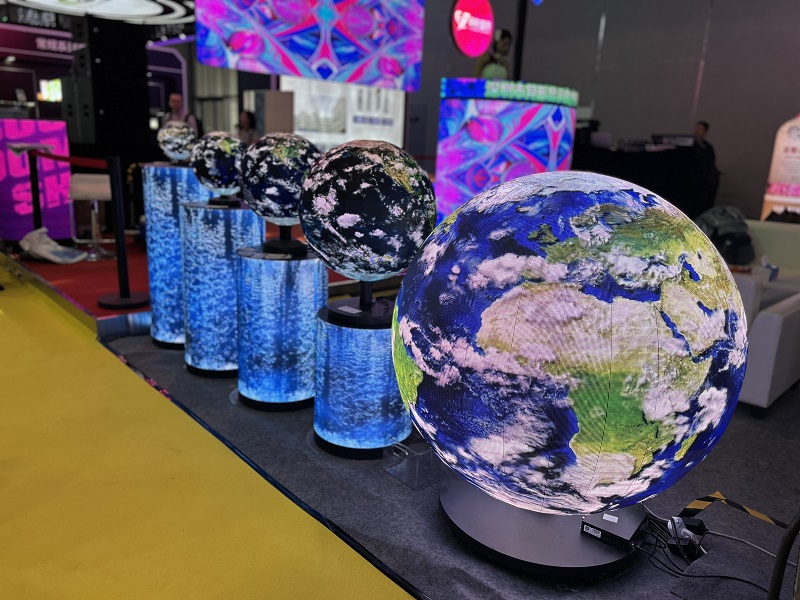
A spherical LED display differs completely from a traditional flat LED screen.
Because the display surface wraps around a sphere, viewers can see content from almost any direction.
As a result, spherical LED screens naturally provide ultra-wide viewing coverage.
The theoretical horizontal viewing angle of a spherical LED screen is:
360^circ
This means viewers can walk completely around the sphere and continue seeing display content from every direction.
The theoretical vertical viewing angle is:
180^circ
This covers the visible area from the bottom of the sphere to the top.
Traditional flat LED displays only emit light in one primary direction.
However, spherical LED screens distribute LED modules across the entire curved surface.
Therefore:
Every viewing direction becomes a “front-facing” viewing position
No single fixed normal direction exists for the entire display
Viewers receive consistent visual coverage from all sides
This structure allows spherical LED screens to deliver true panoramic visibility.
In real-world applications, manufacturers usually describe spherical LED displays as offering:
“360° full viewing angle”
“All-direction visibility”
“Panoramic visual coverage”
This description focuses mainly on horizontal viewing because viewers commonly move around the sphere laterally.
Although spherical LED screens theoretically provide 360° visibility, several practical factors still influence the real viewing effect.
Each LED chip still has its own optical emission angle.
Therefore, the brightness may vary slightly at extreme side viewing positions.
Smaller pixel pitch improves image clarity at close viewing distances.
Large pixel pitches may reduce visual consistency around curved surfaces.
The smoother the sphere assembly, the more uniform the viewing experience becomes.
Poor curvature precision may create brightness inconsistencies between modules.
Strong environmental lighting can reduce perceived viewing quality from certain directions.
The viewing angle of an LED display refers to the angle range where brightness remains above 50% of the front-facing brightness level.
For traditional flat LED screens, manufacturers calculate the viewing angle by measuring brightness reduction relative to the screen’s normal direction.
Spherical LED displays work differently.
Because the display surface surrounds the entire structure, spherical LED screens naturally achieve:
360° horizontal viewing
180° vertical viewing
As a result, viewers can see content clearly from almost any direction around the sphere, making spherical LED displays ideal for immersive advertising, exhibitions, museums, commercial spaces, and creative visual installations.
 +86 18688923792
  andy@tosled.com