

Industry news


View: 526

Release time:2026-03-26
Setting up an LED screen for a trade show requires a different mindset than designing for concerts or permanent installations. You need to move fast, control costs, and still deliver strong visual impact in a limited space. If you approach it methodically, you can avoid common pitfalls and maximize your return.
Before selecting any hardware, you should clearly define the environment you’re working in.
Trade shows typically involve:
Limited booth space – Attendees often stand very close to the screen (around 1–2 meters)
Tight setup windows – Installation and dismantling may be restricted to just a few hours
Budget sensitivity – You must balance visual performance with rental and logistics costs
These constraints directly influence every technical decision that follows.
Pixel pitch is the most critical parameter because it determines how your content looks at close range.
Viewing distance rule: Since attendees approach the screen closely, you need a fine pitch
Recommended range: P1.5 to P2.6
What to avoid: P3.9 or above, as visible pixelation will degrade brand perception
If you need a cost-performance balance, P2.6 often delivers the best compromise. It maintains decent clarity while keeping rental costs manageable.
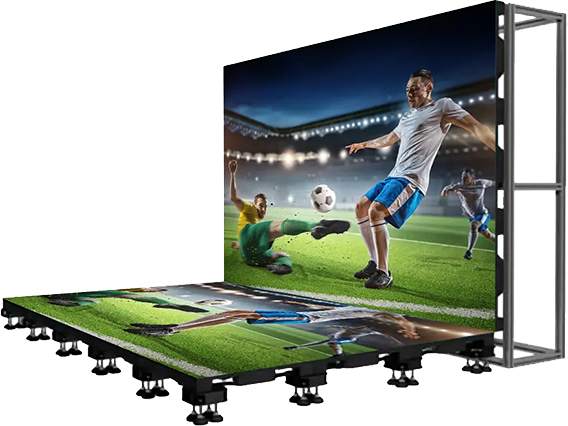
Next, you should determine how to physically install the screen. This decision affects both cost and setup time.
Uses weighted bases to support the structure
Does not require ceiling rigging
Reduces venue-related costs significantly
Requires venue approval and additional fees
Increases complexity and setup time
For most trade show booths, ground stacking is the most efficient and cost-effective solution.
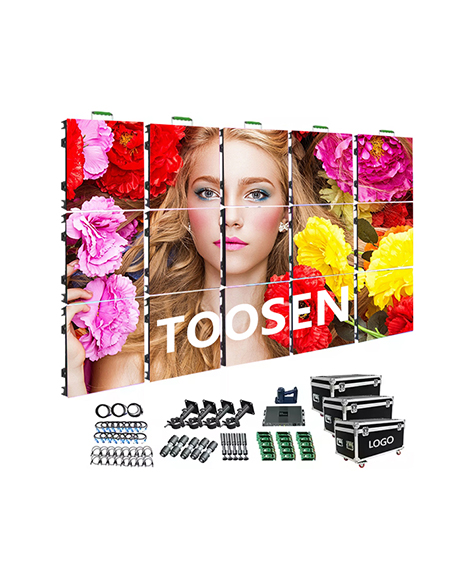
Additionally, modular frame systems allow LED panels (including customized solutions from brands like Toosen) to integrate seamlessly into booth structures, creating a clean, wall-like appearance.
Once the physical setup is clear, focus on signal processing and control.
Systems from Novastar dominate the market due to their reliability and flexibility. Common recommendations include:
VX4S
VX1000
These processors allow precise control over resolution, scaling, and mapping.
Even in small booths, you should implement signal backup (redundancy):
Use loop backup for data connections
Ensure the screen remains operational if one cable fails
This small investment can prevent costly downtime during the event.
One of the most overlooked steps is content preparation.
LED walls rarely use standard 16:9 formats. Instead, their resolution depends on the physical configuration (e.g., 1536 × 768).
You should:
Finalize the LED wall dimensions first
Produce content that matches the exact pixel resolution
Otherwise, your visuals may appear stretched or compressed.
Trade show halls are usually well-lit, but excessive brightness can harm the viewing experience.
Recommended brightness: 800–1200 nits
Avoid overly bright settings that cause glare or visual fatigue
Balanced brightness improves both comfort and perceived image quality.
Experienced engineers consistently highlight a few critical details:
Instead of purchasing your own LED wall:
Rent from local suppliers
Ensure they provide spare modules (typically ~10%)
Rely on their on-site technical support
This approach reduces risk and simplifies logistics.
For ground-supported installations, leveling is critical:
The first row must be perfectly horizontal
Even a 1 mm deviation can cause visible gaps in higher rows
Bring proper leveling tools and allocate time for precise alignment.
LED walls consume significant power, especially under full-white content.
You should:
Calculate maximum power draw, not average consumption
Communicate this requirement to the venue in advance
Distribute power loads properly to avoid circuit overload
Failing to plan power correctly can lead to tripped breakers and downtime.
To build a successful LED display for a trade show, you should start with environment constraints, then move to pixel pitch, installation method, and control system. After that, focus on content preparation and operational details like leveling and power.
In short, trade show LED setups demand efficiency and precision. If you plan each step carefully and collaborate with experienced rental providers, you can create a high-impact display without overspending or overcomplicating the process.
 +86 18688923792
  andy@tosled.com