News
Most genuine customer feedback, highly informative technical support videos, and our latest updates!
Most genuine customer feedback, highly informative technical support videos, and our latest updates!

View: 20

Release time:2026-09-13
A bottle-shaped LED display looks simple from a distance. It has a body, a shoulder, a neck, and sometimes a narrow top. But these changes in diameter make the screen very different from a normal cylindrical LED display.
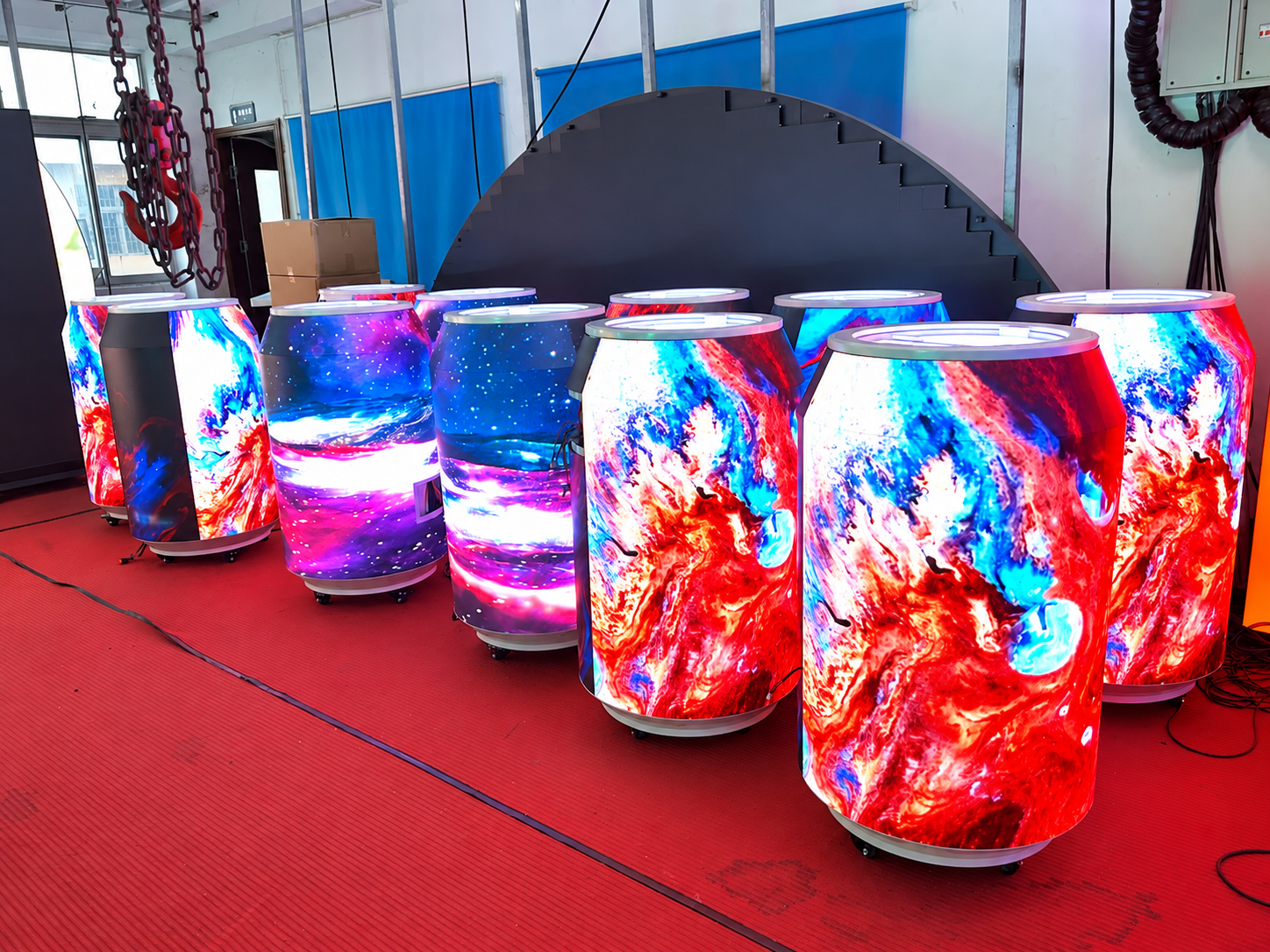
For a straight can-shaped screen, standard flexible LED modules can often wrap around the structure without major changes. A bottle is more difficult. The circumference becomes smaller as the screen moves from the body toward the neck. If the same pixel arrangement is forced onto every part of the bottle, gaps, stretched images, uneven seams, or distorted content may appear.
This is when a custom pixel layout for a bottle-shaped LED display becomes important.
A normal LED module uses a regular matrix. For example, LEDs are arranged in straight rows and columns with a fixed pixel pitch.
A custom pixel layout changes this arrangement to match a special screen shape.
It does not always mean changing the pixel pitch itself. In many projects, the main pixel pitch may remain P1.9, P2.5, P3, or another specification. What changes is the number of pixels, PCB outline, module width, or pixel distribution in different areas of the bottle.
This allows the LED surface to follow the real geometry more accurately.
For a bottle-shaped LED screen, the goal is not simply to cover the structure with LEDs. The goal is to keep the visible pixel distribution smooth when the diameter changes.
Not every bottle LED display needs a completely customized PCB.
If the design has a long cylindrical body and only a small change near the top, standard flexible LED modules may cover most of the display.
This works especially well when:
The bottle diameter is relatively large.
Most of the LED area has a constant radius.
The shoulder transition is short.
The viewing distance is relatively long.
The content does not require precise alignment around the full 360° surface.
In this situation, manufacturers can combine standard flexible modules with specially designed structural sections.
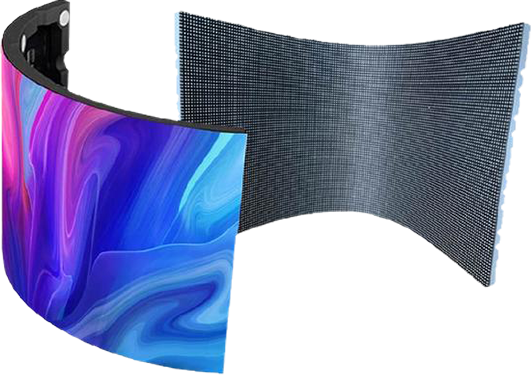
Toosen's Flexible LED Screen solutions are suitable for curved and irregular structures and can be used as the basic display technology for cylindrical and bottle-shaped installations.
The bottle shoulder is usually the most difficult area.
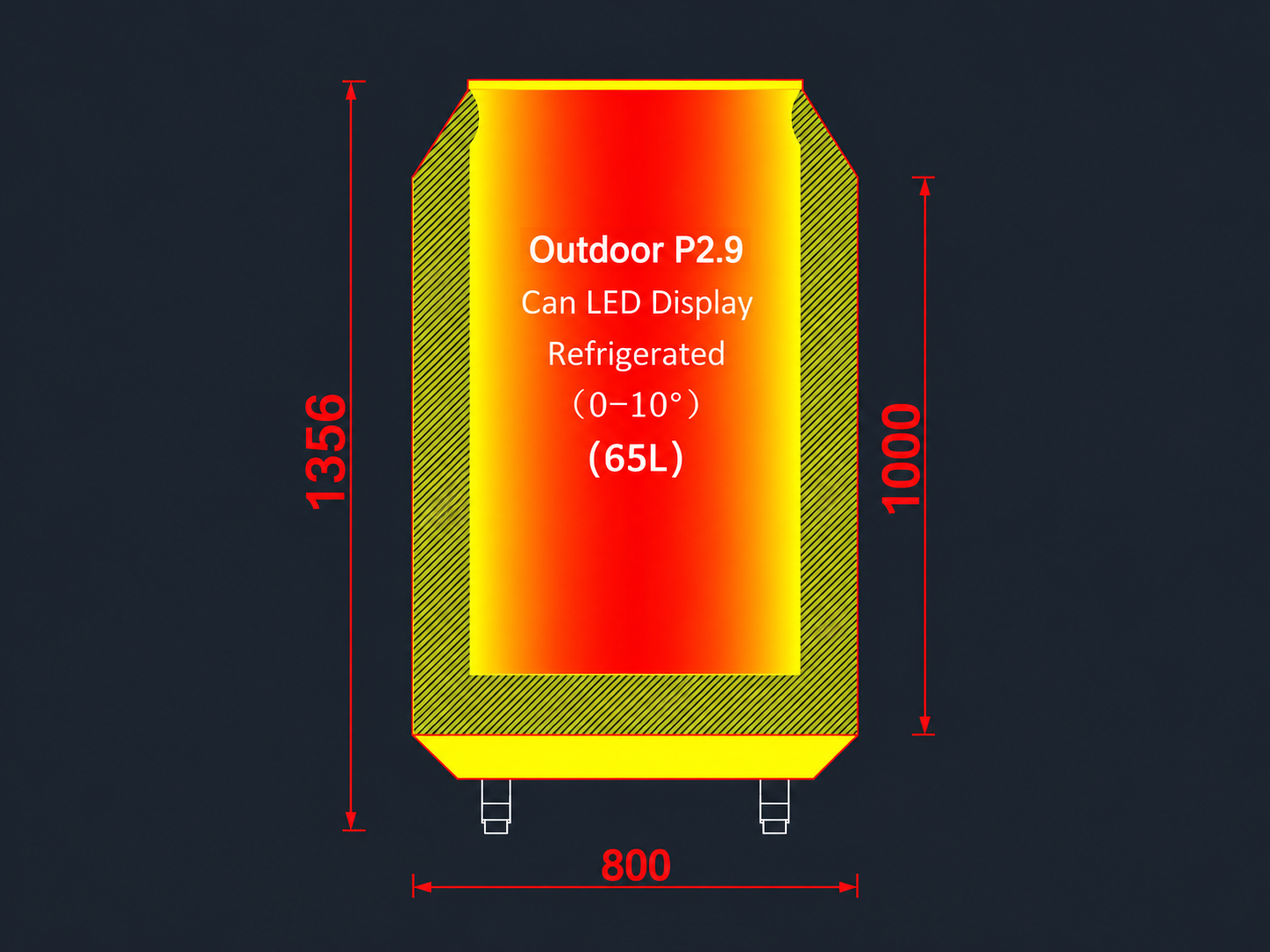
Imagine a bottle with a 700 mm body diameter but a neck diameter of only 250 mm. The circumference becomes much smaller over a short vertical distance.
If every horizontal LED row contains the same number of pixels, the modules cannot naturally follow this change.
Engineers may need to gradually reduce the number of pixels around each horizontal section.
The body may use one layout, the shoulder another, and the neck a third.
This creates a smoother transition instead of forcing rectangular modules into a narrowing surface.
Flexible modules can bend, but bending ability does not solve every problem.
There is always a physical limit determined by PCB size, module width, LED spacing, connectors, and the minimum bending radius.
For example, Toosen's bottle and can LED solutions can use curved structures with a minimum radius around 35 mm in certain designs. However, the final module configuration still depends on the bottle geometry.
If the neck becomes too narrow, a standard module may physically fit the curve but still produce an incorrect pixel distribution.
A smaller customized module or special PCB may be more suitable.
A 360-degree bottle display eventually has to close around itself.
This is an important point that is easy to overlook.
Suppose the calculated circumference requires 238 pixels, but the available module combination creates 240 pixels. Those extra pixels cannot simply disappear.
If the difference is pushed into one location, the vertical seam may become wider or the pixel spacing near the seam may look different.
For advertising graphics, this can make a logo or line appear broken when it crosses the back of the bottle.
A custom pixel layout allows the engineering team to design the circumference around actual pixel quantities rather than forcing the mechanical structure to match standard modules.
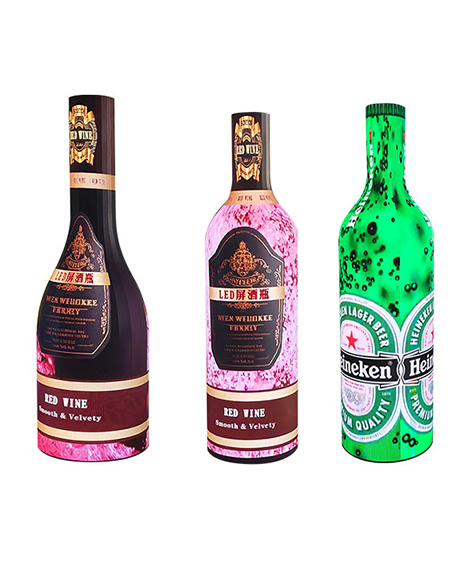
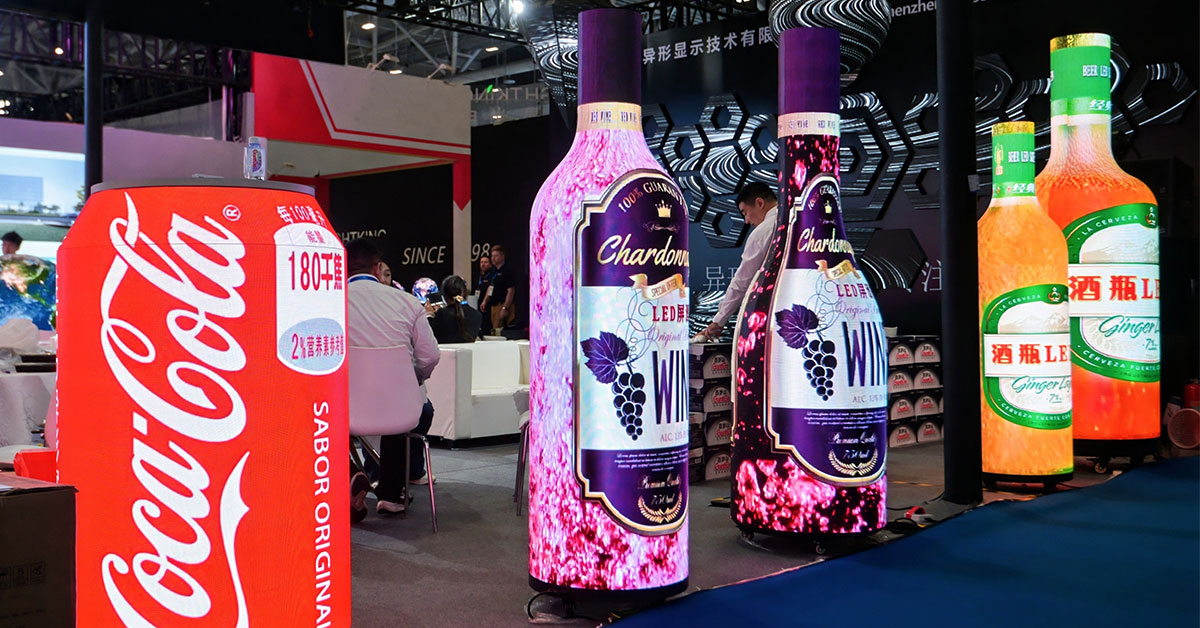
Some bottle-shaped LED displays are designed to reproduce an actual beverage bottle at a much larger scale.
In this case, shape accuracy becomes more important.
The LED shoulder, neck, label area, and body proportions may need to follow the original packaging closely.
A generic cylinder with a narrow top may be acceptable for a decorative installation, but it is usually not enough for a product launch or branded retail display.
The LED structure and pixel map should therefore be developed from the bottle drawing or 3D model.
Toosen's Wine Bottle LED Screen solutions can be customized in different sizes, pixel pitches, and container shapes for this type of project.
Custom layout should not be decided only during assembly.
The engineering team should first build the bottle geometry and divide it into several horizontal sections.
For each section, they can calculate:
Circumference = π × Diameter
The circumference can then be compared with the selected pixel pitch.
For example, a 1,000 mm diameter section has a circumference of approximately 3,142 mm.
With a P2.5 layout:
3,142 ÷ 2.5 ≈ 1,257 pixels
The actual design must then be adjusted according to module dimensions, PCB structure, seams, installation tolerance, and control-card mapping.
The same calculation should be repeated at the body, lower shoulder, upper shoulder, and neck.
This quickly shows where standard modules work and where customization becomes necessary.
A physical lighting test is also important.
Before completing the full bottle-shaped LED display, engineers should test several types of content:
horizontal lines;
vertical lines;
grids;
circles;
moving text;
full-screen solid colors;
graphics crossing the 360° seam.
Grid images are especially useful.
If a grid bends suddenly around the shoulder or changes width near the neck, the problem may come from the pixel layout rather than the video file.
The test also helps engineers check module alignment, receiving-card mapping, color consistency, and seam position.
A practical bottle-shaped LED display often uses a mixed solution.
The large cylindrical body can use standard flexible modules, while only the difficult shoulder and neck areas use customized PCB shapes.
This approach reduces unnecessary development cost while keeping the important visual areas accurate.
For highly irregular projects, a broader Shaped LED Screen engineering solution may also be used to combine custom modules, metal structures, control systems, and installation design.
The correct question is therefore not:
“Should the whole bottle use custom modules?”
It is:
“Which areas cannot maintain the required pixel spacing and geometry with standard modules?”
That distinction can significantly simplify the project.
No. A smaller pixel pitch increases resolution, but it also increases the number of LEDs and makes the module geometry more demanding. The bottle diameter, viewing distance, bending radius, and content requirements should be considered together.
Flexible LED technology can handle many curved surfaces, but extreme diameter changes, narrow necks, complex shoulders, and unusual contours may still require custom PCB layouts or specially sized modules.
The shoulder has a changing circumference. If the pixel map does not follow that geometry, the same image width is forced into a smaller physical area, which can cause visible compression or distortion.
The hardest part of a custom bottle-shaped LED display is often not bending the screen. It is controlling how the pixel grid changes as the shape becomes narrower.
A standard layout is sufficient for many simple cylindrical areas. But when the bottle has a sharp shoulder, small neck, strict branding proportions, or a difficult 360° closing seam, a custom pixel layout can prevent visible gaps and image distortion.
The best result comes from checking the bottle geometry, pixel pitch, module dimensions, content mapping, and mechanical structure before production begins.
Shenzhen Toosen Optoelectronics Co., Ltd. provides OEM and ODM solutions for flexible, bottle-shaped, spherical, and other custom-shaped LED displays. With engineering support for customized dimensions, pixel pitches, structures, and indoor or outdoor applications, Toosen can develop the LED surface and mechanical design together according to the actual project shape.
 +86 18688923792
  andy@tosled.com