


News
Most genuine customer feedback, highly informative technical support videos, and our latest updates!
Most genuine customer feedback, highly informative technical support videos, and our latest updates!

View: 173

Release time:2026-09-30
When buyers compare a COB LED display, pixel pitch, brightness, resolution, and screen size usually get most of the attention. Cabinet depth is often treated as a secondary specification.
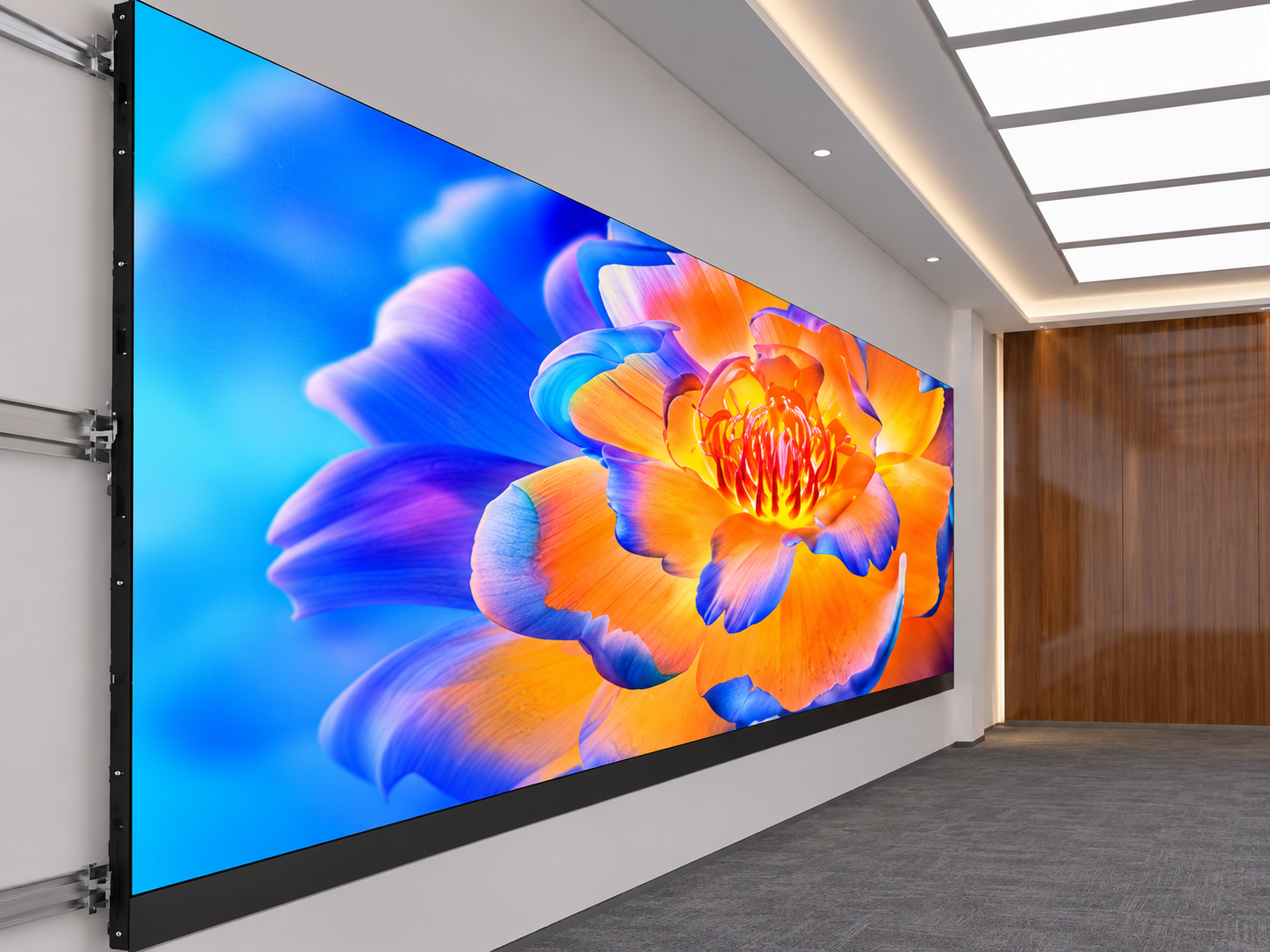
In real projects, however, the depth of a COB LED display cabinet can affect much more than appearance. It changes the required installation space, airflow design, wall structure, cable routing, maintenance method, and even long-term service cost.
A cabinet that is only a few centimeters deeper may require a different wall structure. A cabinet that is too thin may look cleaner, but it can also create cooling or maintenance problems if the internal layout is not designed correctly.
For this reason, cabinet depth should be checked before the screen structure is finalized.
Cabinet depth is the distance from the front display surface to the back of the cabinet.
For a wall-mounted COB LED display screen, this dimension directly affects how far the finished screen projects from the wall.
A shallow cabinet can help create a cleaner appearance, especially in:
meeting rooms
control rooms
showrooms
command centers
retail stores
corporate reception areas
However, reducing cabinet depth without considering internal space can create several problems.
Power supplies, receiving cards, HUB boards, cables, connectors, and heat dissipation channels all need enough space.
If these parts are packed too tightly, installation may become more difficult and future maintenance can take longer.
A deeper COB LED display cabinet normally requires more space behind the display.
For example, imagine that a customer wants the LED screen to appear almost flush with the wall.
If the cabinet itself is already relatively deep, installers may need to build a larger recessed wall opening or increase the distance between the structural frame and the original wall.
This affects several parts of the project.
The supporting steel structure may become thicker. The decorative wall may need to move forward. Cable trays may need additional space. The final screen may also project farther into the room.
In narrow corridors, meeting rooms, control rooms, or retail environments, even a small difference in screen depth can affect the available walking or working area.
That is why the installation team should confirm both the cabinet depth and the total finished installation depth.
They are not always the same.
COB technology offers good protection and thermal characteristics, but the complete LED display still produces heat.
Heat comes from LEDs, driver ICs, power supplies, control electronics, and conversion losses.
The internal cabinet structure determines how this heat moves away from these components.
A deeper cabinet usually gives engineers more freedom to create airflow space between components.
Power supplies can be separated from sensitive electronics, and air can move more easily around hot areas.
A very thin cabinet has less internal volume.
If components are placed too close together, localized heat may build up around the power supply or driver area.
This does not mean that a thin cabinet is automatically worse.
A well-designed thin COB LED display can still achieve good thermal performance.
The key is whether the internal structure, metal heat transfer path, ventilation design, and component layout have been engineered for the reduced depth.
Thermal performance should not be judged only from the cabinet drawing.
The screen should be tested under realistic working conditions.
A useful test includes several steps.
First, operate the display for a long period using bright content.
Then check the temperature around:
power supplies
driver IC areas
receiving cards
cabinet joints
cable connection points
A thermal camera can help identify local hot spots.
Engineers should also compare the center cabinets with cabinets near the screen edges.
If one area consistently runs hotter, the internal airflow or component layout may need adjustment.
For large COB LED display projects, this test should be completed before mass installation.
It is much easier to modify the cabinet structure in the factory than after hundreds of cabinets are already fixed to a wall.
Maintenance cost is another important factor.
Some COB LED display systems are designed for complete front maintenance.
Modules, power supplies, receiving cards, and cables can be serviced from the front.
This type of design can greatly reduce the need for rear service space.
In this situation, a shallow cabinet is especially useful because the display can sit closer to the wall.
Other projects still require rear maintenance access.
If rear access is necessary, the total space requirement can become much larger than the cabinet depth itself.
For example, a cabinet may only be several centimeters deep, but technicians may still need a service passage behind the display.
That service passage increases the construction area and can raise installation costs.
Therefore, buyers should not ask only:
“How deep is the cabinet?”
They should also ask:
“Can every important component be replaced from the front?”
Maintenance cost is not only the price of replacement parts.
Labor time is also important.
If the inside of a cabinet is too crowded, technicians may need to remove several components before reaching one failed power supply or cable.
Connectors can also become difficult to inspect.
This makes routine service slower.
In contrast, a cabinet with a clear internal layout allows technicians to identify and replace components more quickly.
For commercial projects that operate every day, faster maintenance means less screen downtime.
Over several years, this difference can become more important than the original cabinet price.
Cabinet depth cannot be separated from other parts of the display.
The final design should consider:
COB modules
cabinet frame
power supplies
receiving cards
HUB boards
power cables
signal cables
magnetic or mechanical fixing systems
heat transfer structure
maintenance access
Changing one component may affect the required cabinet depth.
For example, a different power supply size may require more internal clearance.
A new cable routing method may allow the cabinet to become thinner.
A front-service power box can also reduce the need for rear access.
This is why cabinet design should be completed as one system rather than as separate parts.
Consider a fine-pitch COB LED display installed in a corporate meeting room.
The customer wants a clean wall-mounted appearance and very little distance between the screen and the finished wall.
If a deeper cabinet is selected, the contractor may need to build a larger supporting frame and move the decorative wall forward.
This increases construction work.
If a well-designed shallow cabinet with full front maintenance is used, the LED screen can be installed closer to the wall.
The room keeps more usable space, and technicians can service the display without entering the rear area.
In this type of project, the correct cabinet depth can reduce both installation work and future maintenance time.
No. A thinner cabinet can save space and improve appearance, but internal cooling, component layout, cable routing, and maintenance access must still be reasonable.
It can provide more internal space for airflow and component separation, but cabinet depth alone does not guarantee better cooling. Thermal design is more important.
Yes. Many COB LED display systems can be designed for front maintenance, allowing modules, power supplies, and control parts to be serviced from the front.
Yes. Cabinet depth, mounting structure, cable space, ventilation, and maintenance access should all be confirmed before the wall and steel structure are finalized.
At Toosen, cabinet design is considered together with installation conditions, heat management, maintenance access, and project structure.
For different COB LED display projects, the most suitable cabinet depth may be different.
A meeting room may require an ultra-slim front-service structure, while a large commercial installation may need more internal space for power distribution and thermal management.
The goal is not simply to make the cabinet as thin as possible.
The better approach is to use the right depth for the actual installation environment, cooling requirement, and maintenance method.
A properly designed COB LED display cabinet can reduce construction complexity, improve thermal stability, shorten service time, and lower long-term maintenance cost.
Learn more about COB LED display solutions at Toosen: https://www.toosen.com/
 +86 18688923792
 andy@tosled.com