News
Most genuine customer feedback, highly informative technical support videos, and our latest updates!
Most genuine customer feedback, highly informative technical support videos, and our latest updates!

View: 54

Release time:2026-09-09
A flexible LED module can bend, but that does not mean it can support itself.
This is one of the most important differences between a flexible LED screen and a normal flat LED display. The soft module creates the visible curve, while the structure behind it determines whether that curve stays accurate after installation.
For a simple curved wall, an existing surface may provide enough support. But for cylinders, waves, columns, suspended displays, or irregular shapes, a custom metal frame often becomes necessary.
So, when should you use one?
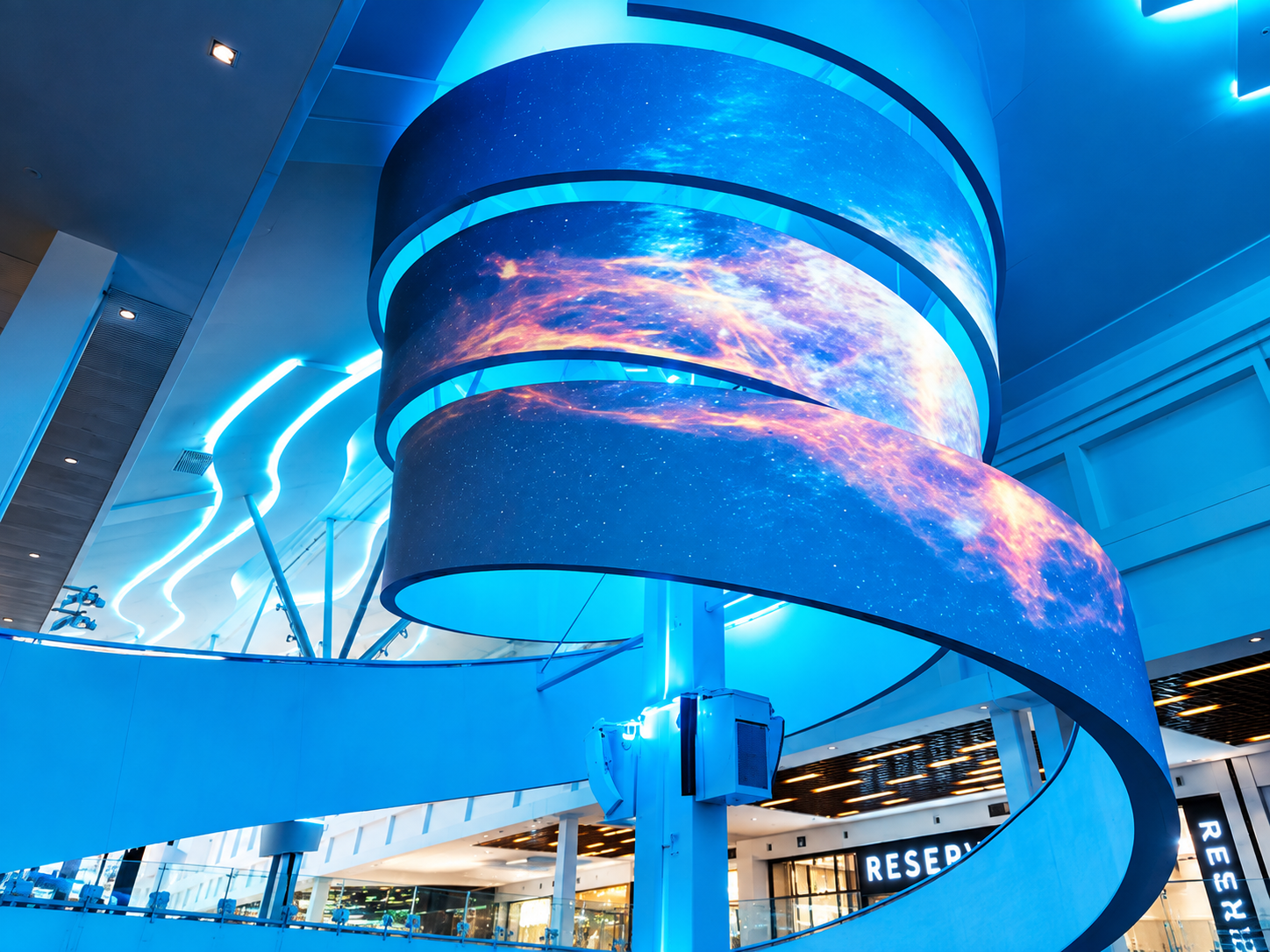
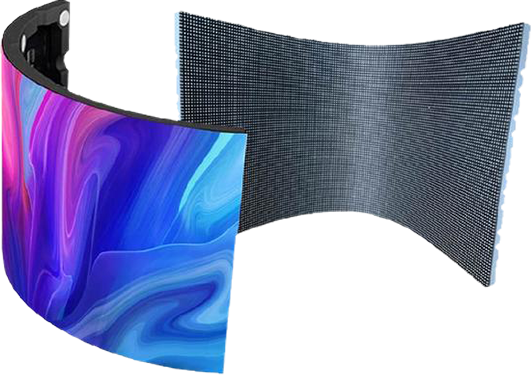
A flexible LED displayis designed to follow a curved surface. Its soft PCB and flexible backing make it possible to create shapes that standard rigid LED modules cannot achieve.
However, the module itself is not the main load-bearing structure.
If modules are installed directly onto an uneven or poorly prepared surface, several problems can appear:
inconsistent curvature
visible gaps between modules
uneven screen edges
difficult cable routing
unstable module positioning
poor maintenance access
local stress on modules and connectors
The problem becomes more noticeable as the screen gets larger or the shape becomes more complicated.
A good curved LED display therefore starts with the structure, not only with the LED module.
This is one of the clearest situations where a custom metal frame is needed.
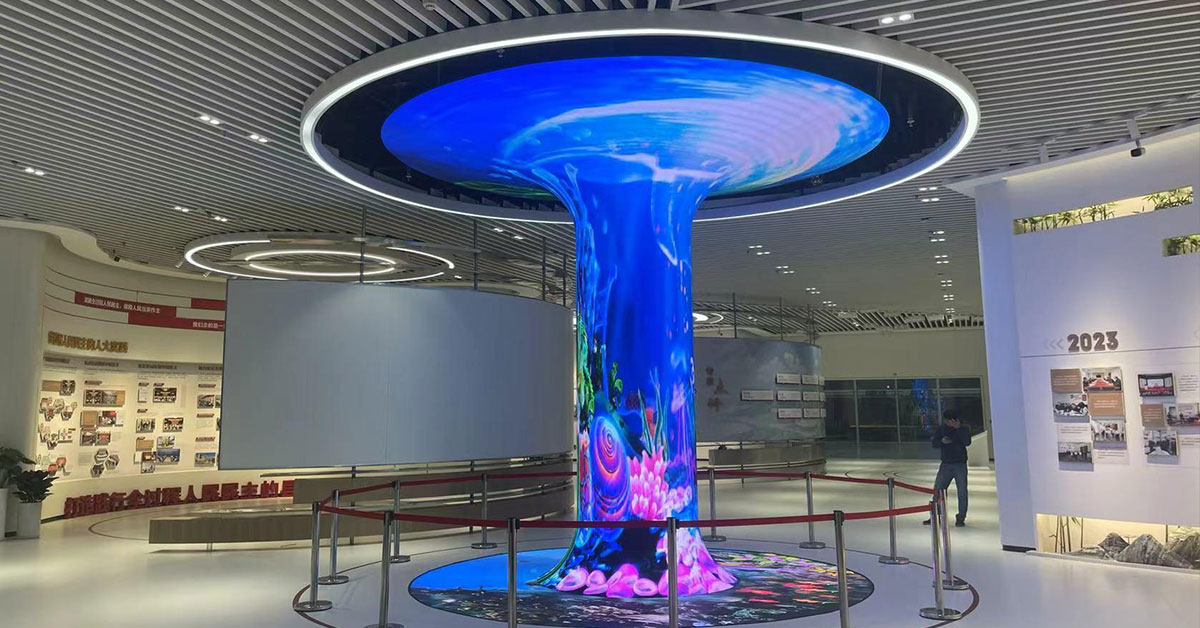
Imagine that an architect wants a smooth cylindrical LED column, but the existing concrete column is slightly uneven. Installing flexible LED modules directly onto it may reproduce every surface error.
Instead, engineers can build a circular metal frame around the original column.
The frame creates a controlled mounting surface, while the flexible LED modules create the final display surface.
This method is especially useful for:
shopping mall columns
exhibition structures
hotel interiors
museum installations
retail displays
architectural decorations
For these projects, the frame works like a geometric reference for the entire screen.
Flexible does not mean unlimited bending.
Every LED soft module has a practical bending range. If a project requires a specific radius, engineers need to check whether the module can follow that curve without excessive mechanical stress.
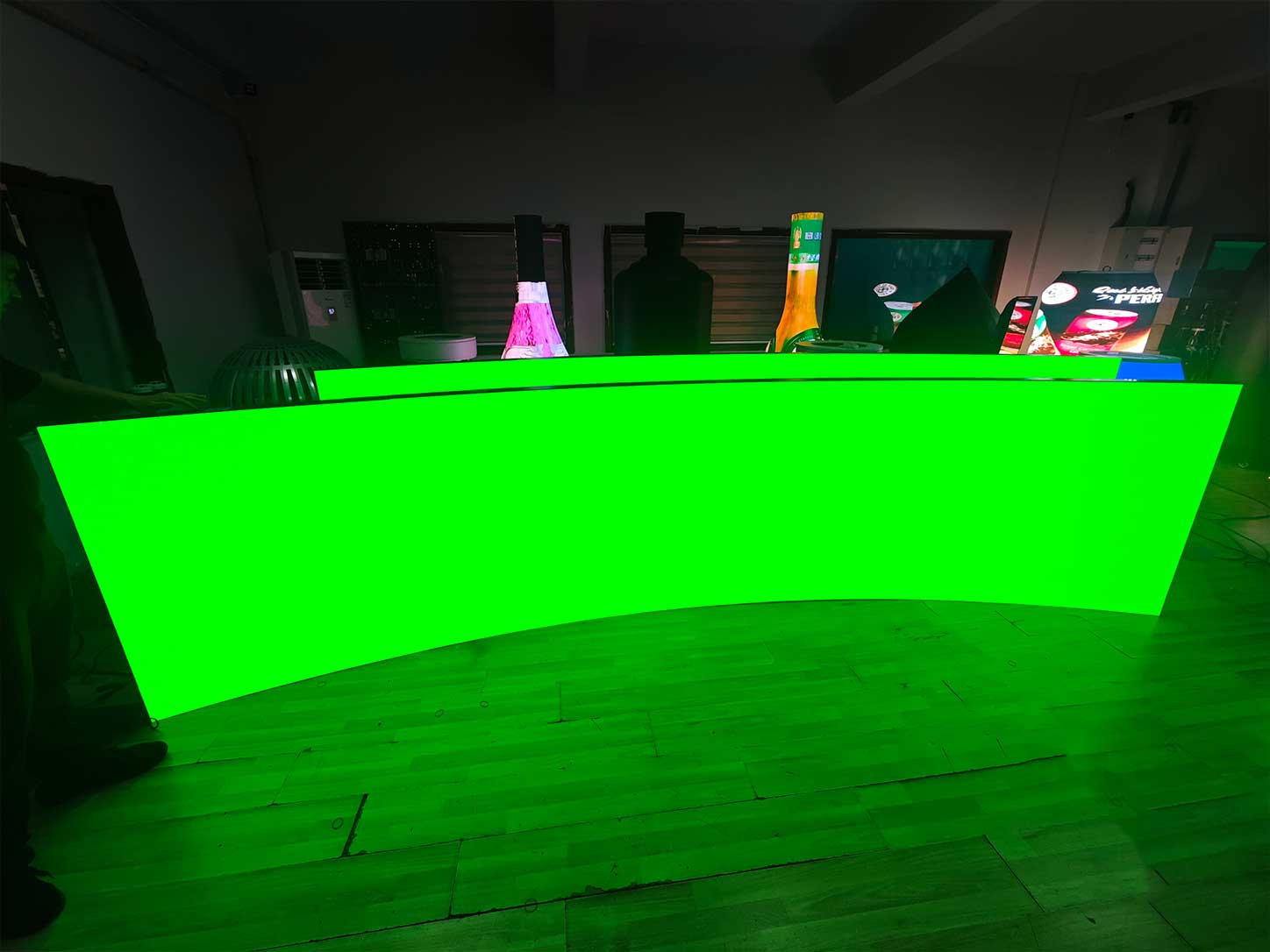
A custom metal frame helps maintain the designed radius across the whole display.
For example, if a cylindrical screen is slightly wider at the top than at the bottom because of installation errors, the difference may look small mechanically but become obvious when video content moves around the screen.
This is why the frame should be designed according to the final LED surface rather than adjusted only after the modules arrive.
A simple cylinder has one relatively consistent curve.
A wave-shaped display is different.
Its radius can change continuously from one section to another. Some areas bend inward, while others bend outward. This makes installation much more dependent on structural accuracy.
In this situation, a custom metal frame for flexible LED modules can divide the shape into controlled structural sections.
Engineers can define several reference points along the frame and then install the LED soft modules according to these points.
This reduces the risk of creating an uneven wave by manually adjusting each module on site.
For highly customized shapes, TOOSEN also provides customized LED displaysolutions based on drawings, dimensions, and project requirements.
A wall already provides support.
A suspended structure does not.
If a curved or creative LED screen is hanging from a ceiling or overhead structure, the metal frame becomes part of the complete load-bearing system.
The engineering team must consider more than the LED modules themselves. The design may also need to support:
power supplies
receiving cards
signal cables
power cables
mounting hardware
maintenance components
The total weight and load path should be evaluated before fabrication.
For this type of project, the flexible LED module should never be treated as a structural component.
Curved screens are sensitive to small alignment errors.
If one module sits slightly higher than the next, the difference can create a visible seam. When many small errors accumulate across a large screen, the final shape can gradually move away from the original design.
A properly manufactured metal frame provides fixed reference positions.
This makes it easier for installers to control:
Module position → module gap → curvature → complete screen geometry
The larger the screen, the more valuable these reference points become.
Do not wait until all modules are installed to discover a structural problem.
A better approach is to test the metal frame first.
Start by checking the overall dimensions against the approved drawing. Then measure several important points instead of checking only the total width and height.
For curved sections, use a radius template, laser measurement, or another suitable measuring method to verify the shape.
Next, install a small number of flexible LED modules in the most difficult area.
Pay special attention to:
the smallest radius
transitions between different curves
corners or edge sections
module joints
cable exits
maintenance openings
This small trial installation can reveal problems before hundreds of modules are mounted.
After the structure is confirmed, complete the screen and run a full-image test. Moving lines, grids, and continuous graphics are useful because structural discontinuities are often easier to see than with a static photo.
No.
For a small indoor installation on an existing smooth curved surface, a separate custom frame may not be necessary.
A metal structure becomes more important when the project involves:
| Project Condition | Custom Frame |
|---|---|
| Small curved wall with a prepared surface | Usually optional |
| Existing smooth cylindrical structure | Depends on accuracy |
| Large LED column | Recommended |
| Wave-shaped LED wall | Recommended |
| Irregular creative shape | Usually required |
| Suspended curved display | Usually required |
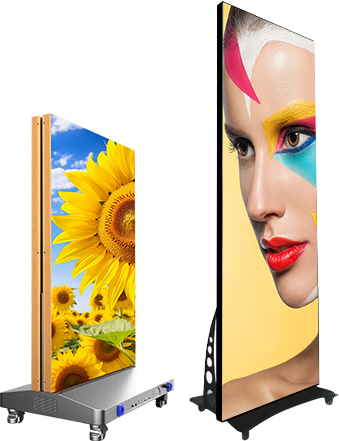
| Self-standing flexible LED display | Required |
| Complex architectural installation | Usually required |
The decision should therefore be based on geometry, size, mounting method, structural load, maintenance access, and installation tolerance, rather than screen size alone.
One mistake in custom frame design is making the structure fit the LED modules perfectly but leaving no room for service.
Before manufacturing the frame, engineers should decide how technicians will reach the power supplies, receiving cards, cables, connectors, and individual LED modules.
For a large curved LED screen, a few centimeters of extra service space in the correct location can save hours during future maintenance.
The frame should also avoid blocking module removal paths.
A beautiful curved screen is only a good design if it can still be repaired after installation.
Yes, if the wall or supporting surface is smooth, strong, correctly curved, and suitable for the mounting system. Large or complex shapes usually require additional structural support.
Steel and aluminum are common choices. The final material depends on screen size, weight, installation environment, structural requirements, transportation, and project design.
A flexible LED module provides bending ability, but the custom metal frame controls the final geometry.
For a small curved wall, the existing installation surface may be enough. For a large cylinder, wave, suspended display, self-standing screen, or irregular structure, a custom frame can become a critical part of the project.
The best time to solve structural problems is before production—not during installation.
TOOSEN specializes in flexible and custom-shaped LED display solutions, providing support from project assessment and structural planning to LED module selection, manufacturing, installation guidance, and after-sales service. For projects with unusual curves or dimensions, customers can provide drawings, sizes, installation conditions, or design concepts so that the LED modules and supporting structure can be evaluated as one complete system.
 +86 18688923792
  andy@tosled.com