
News
Most genuine customer feedback, highly informative technical support videos, and our latest updates!
Most genuine customer feedback, highly informative technical support videos, and our latest updates!

View: 110

Release time:2026-10-05
A sphere LED screen may already look complete after installation. The structure is fixed, the modules are working, and the video plays correctly. However, one important step should still be completed before final handover: measuring the actual power draw of the sphere LED screen.
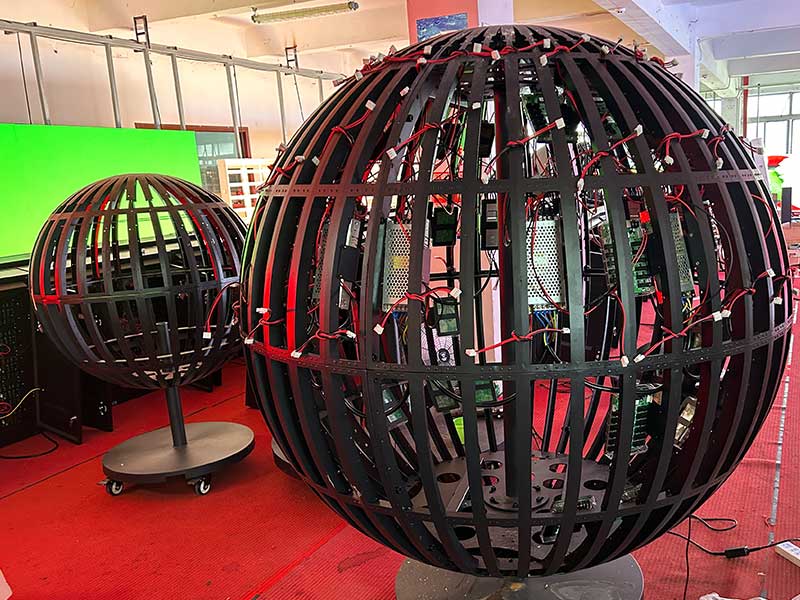
Theoretical power consumption is useful during project design, but the real electrical load on site can be different. Cable length, brightness settings, display content, power supply efficiency, and the number of active modules all affect the final result.
For this reason, power measurement should be part of sphere LED screen project commissioning before the customer accepts the system.
During the early design stage, engineers normally calculate the expected power requirement based on the LED modules, power supplies, controllers, and screen size.
This calculation helps determine:
breaker capacity;
cable size;
distribution box configuration;
power supply quantity;
expected electricity consumption.
But calculation alone does not show exactly how the completed sphere LED screen behaves after installation.
A screen may use much less than its maximum rated power during normal playback. At the same time, a poorly balanced electrical circuit may create high current on one branch even when total power consumption looks acceptable.
That is why commissioning should include real measurements.
Skipping this test can create problems after the project has already been handed over.
For example, a customer may later find that one breaker becomes unusually hot. Another circuit may trip when high-brightness white content appears. In some installations, one electrical branch carries much more load than the others.
These problems do not always appear during short video tests.
Actual power measurement helps identify:
overloaded electrical branches;
uneven current distribution;
unexpectedly high screen consumption;
abnormal power supply behavior;
incorrect brightness settings;
undersized breakers or cables.
Finding these problems during commissioning is much easier than correcting them after the screen enters daily operation.
The rated maximum power of a sphere LED display does not mean the screen continuously consumes that amount.
Actual power depends strongly on displayed content.
A dark video uses relatively little power because fewer LED pixels operate at high output. A colorful commercial video usually creates a medium electrical load. A full-white image at high brightness normally creates one of the highest operating loads.
Brightness also has a major influence.
For an indoor sphere LED screen, operating brightness may be much lower than the maximum available brightness. Therefore, normal operating consumption can be far below the theoretical maximum value.
Other factors include power supply efficiency, module characteristics, screen configuration, voltage level, and power distribution design.
The test should be performed only after the complete screen is installed and operating normally.
First, the electrical team confirms that all LED modules, power supplies, receiving cards, and cooling components are connected correctly.
A clamp meter or electrical power analyzer can then be used to measure current at the main input and individual distribution branches.
Instead of recording only one value, we normally check the screen under several operating conditions.
The sphere LED screen is powered on while displaying a black image.
This measurement shows the basic standby operating load of the control system, receiving cards, power supplies, and related electronics.
The screen then plays the type of video expected during normal use.
Current and power readings are recorded again.
For many projects, this value is more useful for estimating everyday electricity consumption than the maximum rated value.
Finally, a full-white image can be displayed at the agreed operating brightness.
Because red, green, and blue LEDs are driven simultaneously, this condition creates a much heavier electrical load.
The measurement allows engineers to confirm whether the power distribution system still operates safely under a demanding display condition.
For a large sphere LED screen project, checking only the total input power is not enough.
The screen is normally divided into several electrical circuits. Each circuit may supply a different group of modules or sections of the sphere.
Engineers should therefore record the current of every branch.
For example:
| Test Item | What We Check |
|---|---|
| Main input | Total operating current |
| Branch circuits | Load balance |
| Distribution box | Breaker condition |
| Power cables | Abnormal heating |
| Power supplies | Stable DC output |
| Full-white test | Peak operating load |
If one circuit carries significantly more current than another similar circuit, the wiring arrangement should be checked.
The purpose is not simply to obtain a total wattage number. The goal is to understand how the complete electrical system is actually working.
Several parts of a spherical LED display influence its final electrical performance.
The LED module is the main power-consuming component. Power supplies convert AC input power into the DC voltage required by the modules. Power cables distribute current between different sections of the sphere.
The distribution box, circuit breakers, terminals, and connectors must also match the expected electrical load.
For a customized sphere LED screen, correct cable routing is especially important because power lines often need to follow curved internal structures.
Good structural design should allow safe cable routing without excessive bending, loose connections, or unnecessary cable length.
In one indoor sphere LED screen project, the system had already completed module alignment and control configuration. Video playback was stable, and the spherical surface showed no obvious dark areas or mapping errors.
Before final acceptance, the engineering team performed an electrical commissioning test.
Current was first measured with the screen displaying black content. The team then played normal advertising material and recorded the average operating load.
After that, the display showed a full-white test image at the customer’s planned operating brightness.
Each electrical branch was measured separately.
The readings showed that the total operating load remained within the designed capacity, while the difference between the main branches was also within an acceptable range.
These values were added to the commissioning record before the project was handed over.
No. Maximum power is mainly a design reference. Actual consumption changes with brightness, displayed content, and operating settings.
A full-white image activates the RGB LEDs at the same time and creates a high electrical load. It is useful for checking the system under demanding conditions.
For medium and large sphere LED screens, yes. Branch measurements can reveal load imbalance that may not be visible from the total power reading.
Breaker and cable sizing should already be completed during electrical design. Commissioning measurements are used to verify that the installed system operates as expected.
If the brightness setting changes significantly, another measurement is useful because LED brightness directly affects power consumption.
A reliable sphere LED screen project requires more than producing a spherical structure and installing LED modules.
Electrical design, power distribution, module mapping, structural assembly, testing, commissioning, and final inspection all affect long-term operation.
At Toosen, customized LED display projects can be checked according to the actual installation environment and application requirements. For spherical LED projects, we can support structure design, module configuration, control-system planning, power distribution, factory testing, and project commissioning.
Before final handover, checking actual operating power gives both the installer and the customer clearer information about how the completed display performs in real conditions.
For more information about sphere LED screens, spherical LED displays, customized LED displays, and LED display project solutions, visit Toosen.
 +86 18688923792
 andy@tosled.com