

Company news


View: 18

Release time:2026-10-30
Why Does Network Security Matter for a Christmas Tree LED Screen?
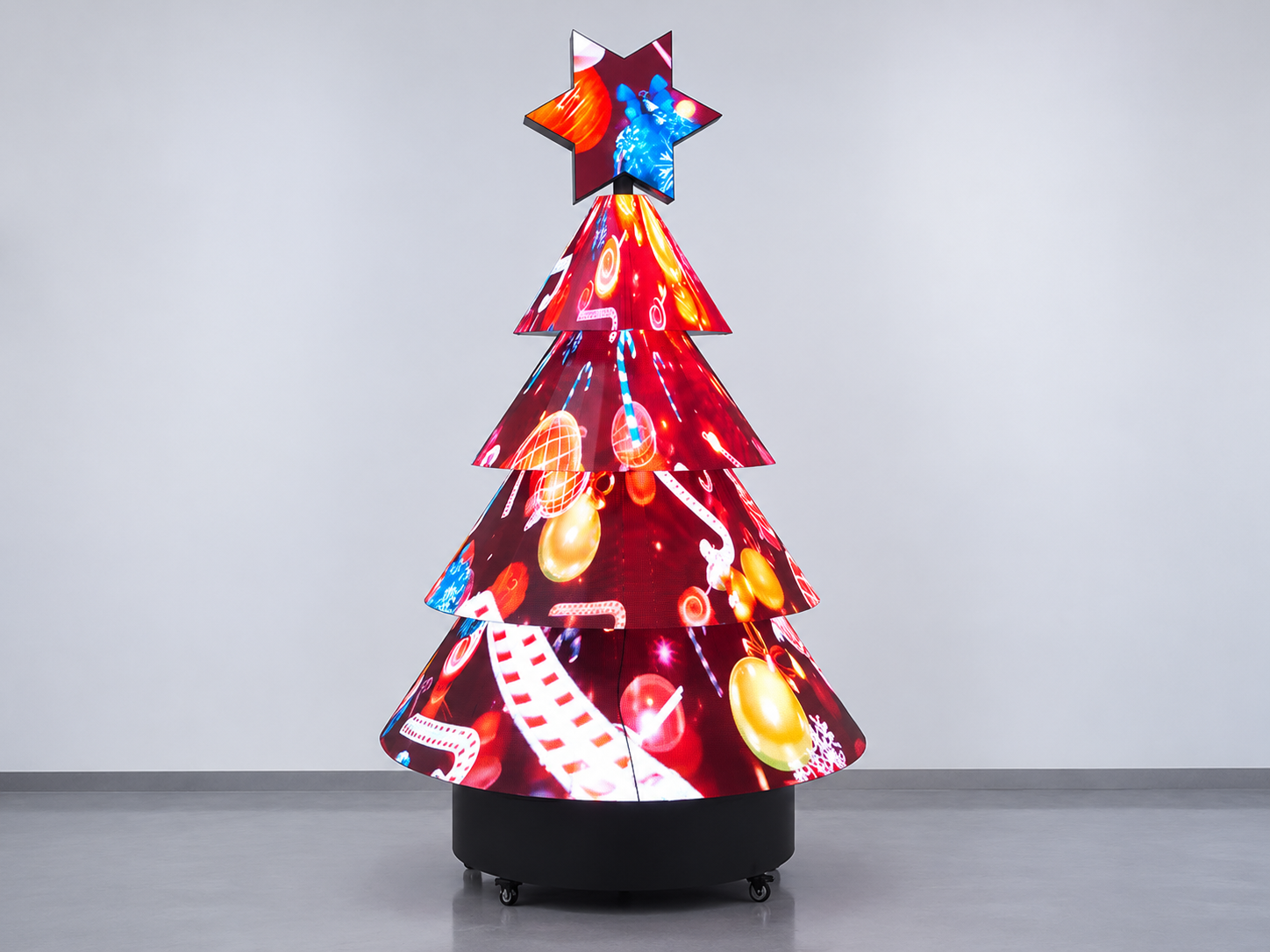
A Christmas Tree LED Screen is often installed in shopping malls, commercial plazas, hotels, entertainment venues, and public event spaces. Many of these displays use remote control systems to upload content, adjust playback schedules, monitor operating conditions, and perform maintenance.
Remote access makes daily operation more convenient. However, connecting an LED display to the internet also creates potential security risks.
If the control system does not have proper protection, unauthorized users may gain access to the display, change playback content, interrupt normal operation, or interfere with system settings.
For buyers, network security should be considered before enabling remote access, not after installation. A reliable Christmas Tree LED Screen should provide convenient management while allowing the owner to maintain control over who can connect to the system.
Several common issues can affect remote management:
Weak passwords: Default or easily guessed passwords make unauthorized access easier.
Shared accounts: When several employees or service providers use the same login, it becomes difficult to identify who made a change.
Unrestricted network connections: An LED control system connected directly to an office or public network may have unnecessary access to other devices.
Outdated software: Old control software or firmware may contain security weaknesses that have not been corrected.
Uncontrolled remote maintenance: Permanent access for external technicians creates additional risks if accounts are not properly managed.
These problems can affect more than the display itself. For a Christmas installation in a busy shopping mall, an unexpected interruption may affect scheduled advertising, seasonal performances, and the visitor experience.
Before purchasing or connecting a Christmas Tree LED Screen, buyers should ask the supplier about the following security measures.
Change all factory-default passwords before connecting the system to a network. Each administrator or operator should have an individual account.
This makes it easier to manage permissions and trace system changes. Where supported, multi-factor authentication (MFA) provides another layer of protection.
The LED display control system should not automatically share unrestricted access with office computers, guest Wi-Fi, or other business systems.
Buyers can ask their IT teams to use a separate network segment, such as a dedicated VLAN, with firewall rules that allow only necessary communication.
External technicians do not always need full administrator access.
For example, a technician responsible for checking system status may only need monitoring permissions. Access for software updates or configuration changes should be granted only when necessary.
Remote maintenance should also have a clear start time, end time, and approval process.
Ask the manufacturer which control software and firmware versions are supported and how security updates are provided.
A clear update procedure is important because the display may remain in operation for several years. Buyers should also confirm whether updates can be tested before being applied to the live system.
Security claims should be checked through practical tests rather than accepted only from product descriptions.
Buyers and installation teams can perform the following checks:
Account test: Confirm that default passwords have been changed and individual accounts work correctly.
Permission test: Log in using an operator account and check whether it is prevented from making restricted administrator changes.
Network test: Ask the IT team to verify that the display can reach required control services but cannot freely access unrelated network devices.
Remote connection test: Confirm that only approved users and authorized connection methods can access the control system.
Connection interruption test: Disconnect the external network and check whether locally stored content and scheduled playback continue as designed.
Recovery test: Verify that authorized personnel can restore the system using a secure backup if a configuration problem occurs.
These tests help buyers understand both the security level and the operational limitations of the proposed system.
A Christmas Tree LED Screen is not just a collection of LED modules. Its complete control chain may include:
LED modules and cabinets: Form the physical display structure.
Sending and receiving cards: Transfer and process display signals.
LED control processor: Manages image processing and signal distribution.
Media player or control computer: Stores and sends playback content.
Network equipment: Routers, switches, firewalls, and related connections.
Control software: Provides content management, system configuration, and remote monitoring.
Buyers should ask which components require network access and which functions can operate locally. Not every component needs an internet connection.
A well-planned architecture reduces unnecessary connections and makes the system easier to manage.
Consider a shopping mall installing a large Christmas Tree LED Screen in its central atrium.
The marketing team needs to update promotional videos and Christmas animations remotely. Meanwhile, the technical team needs to monitor playback and check system conditions without repeatedly accessing the installation area.
A practical setup would assign different accounts to marketing operators and technical administrators. The display control system would use a dedicated network connection, while external maintenance access would require approval and be disabled when no longer needed.
If the internet connection fails, locally stored Christmas content should continue playing if the system is designed to support offline playback.
This arrangement balances convenient content management, operational continuity, and network protection.
Network security depends on more than software. Display structure, control equipment, installation planning, and after-sales technical support also influence long-term operation.
When selecting a Christmas Tree LED Screen manufacturer, buyers should evaluate product customization, control system compatibility, installation guidance, and maintenance support.
Shenzhen Toosen Optoelectronics Co., Ltd. provides LED display solutions for different commercial and creative applications. Buyers can explore its products and project experience at Toosen Official Website.
Before confirming an order, discuss the complete control architecture with the supplier. Request information about supported remote access methods, account management, software updates, local playback, and system recovery.
Clear technical documentation makes it easier for the buyer, installer, and IT team to establish a secure operating environment.
Not necessarily. Basic playback can often operate through a local control system. Internet access is mainly useful for remote content updates, monitoring, and maintenance, depending on the system configuration.
Remote access can be used safely when proper controls are in place. Buyers should check account authentication, network isolation, user permissions, and access logs before enabling it.
Permanent unrestricted access is generally unnecessary. Remote maintenance should be authorized, limited to the required systems, and disabled after the service task is completed.
This depends on the control system. Buyers should confirm whether the display can continue playing locally stored content and whether scheduled playback remains available without an internet connection.
Ask the supplier: Who can remotely access the LED display, what can they control, and how can that access be disabled?
A clear answer helps buyers understand whether the system offers practical security controls rather than simply advertising remote management as a convenient feature.
 +86 18688923792
 andy@tosled.com