
Industry news


View: 959

Release time:2026-01-07
In most retail stores, customers walk in with a clear goal. They want to find products fast and make decisions quickly. Because of this, the most valuable space in a store is not the wall. It is the shelf.
Studies show that shoppers often decide within a few seconds. That is why shelves play a key role in driving sales. If a product does not stand out at the shelf, it may be ignored. So, how can retailers use shelves more effectively to increase conversion rates?
One proven solution is the shelf LED display. In this article, we explain what shelf LED displays are, why they matter, and how they help retail stores sell more.
A shelf LED display is a small, slim LED screen designed for installation on retail shelves. It is usually mounted on the front edge or side of a shelf. Most shelf LED displays come in a long, narrow shape, so they do not block product visibility or take up display space.
In addition, some shelf LED screens come in square or larger formats. These are often used on end caps, promotional areas, or special product zones. Shelf LED displays are widely used in retail stores, showrooms, and product display areas to show prices, promotions, and product details.
Traditional shelf labels have many limitations. First, they are often too small. Customers need to step closer to read them. This reduces visibility and weakens visual impact.
Second, paper labels lack flexibility. Every time a promotion or price changes, staff must replace them manually. This increases labor costs and slows down store operations.
Third, paper labels do not perform well in bright retail environments. Under strong lighting, they are easy to overlook.
In contrast, shelf LED displays solve all these problems. They are digital, dynamic, and easy to update. They can display text, images, and videos. As a result, they bring more flexibility and stronger visual appeal to the shelf.
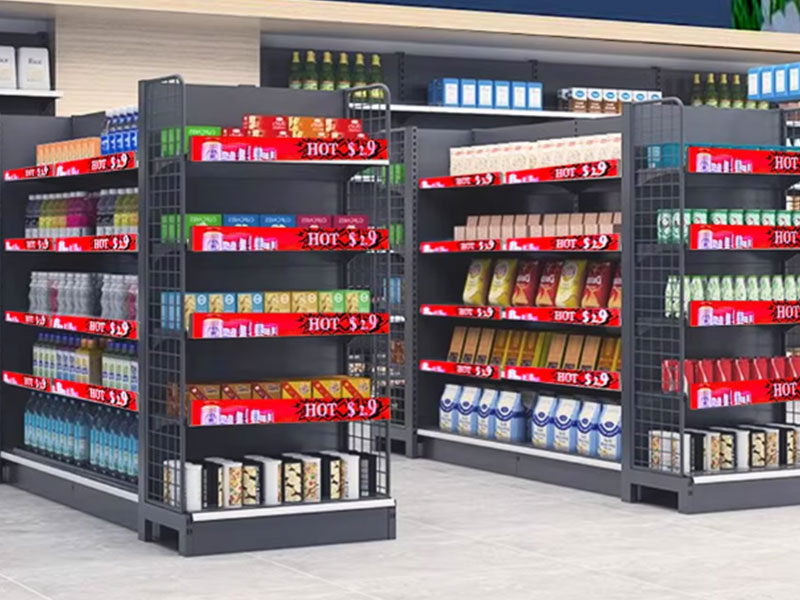
Motion attracts the human eye. Compared with static labels, dynamic LED content is much more eye-catching.
Customers usually stay at a shelf for only a few seconds. Scrolling promotions, flashing prices, and short product animations can break visual monotony instantly. As a result, shoppers notice products faster.
By using shelf LED displays for dynamic advertising, retailers can deliver product messages clearly and directly. This leads to higher engagement and stronger sales performance.
Shelf LED displays are thin and lightweight. This makes installation quick and easy. Most designs use universal mounting structures, so they fit different shelf types.
Maintenance is also simple. Many shelf LED displays support USB plug-and-play. Retailers can update content through mobile apps or centralized systems. In addition, internet-based control allows stores to manage multiple screens at once.
As a result, retailers save time, reduce labor costs, and keep content consistent across the store.
Shelf LED displays use LED backlight technology. Compared with traditional lightboxes, they consume much less power. Many models also support automatic brightness adjustment. They increase brightness during the day and reduce it at night.
This smart control lowers energy costs over time.
In addition, LED displays offer long service life, often reaching tens of thousands of hours. They are more resistant to impact and moisture than paper labels or standard lightboxes. This durability makes them ideal for high-traffic retail environments.
COB (Chip on Board) technology brings shelf LED displays to a higher level. COB shelf LED screens offer excellent protection and image quality.
They are dustproof, waterproof, and moisture-resistant. At the same time, they provide high resolution, high refresh rates, and high contrast. Even at close viewing distances, images remain clear and smooth.
Toosen’s COB shelf LED displays reach a brightness level of 600–800 cd/m². This ensures clear visibility even in bright indoor retail spaces. In addition, they support standard sizes such as 900×60 mm, 600×60 mm, and 300×60 mm strip displays. Custom sizes are also available to match different shelf designs.
Shelf LED displays do more than show information. They guide customer decisions.
By highlighting promotions, key features, and usage scenarios, these displays shorten decision time. They also reduce confusion and improve the shopping experience.
At the same time, centralized content management allows retailers to adjust strategies quickly. Seasonal campaigns, flash sales, and new product launches become easier to execute.
In a competitive retail environment, these advantages make a real difference.
If you want to learn more about shelf LED display solutions, professional support matters.
Toosen is an LED display manufacturer with more than ten years of industry experience. We provide customized shelf LED display solutions based on real retail needs. Our team supports design, production, and technical guidance from start to finish.
Contact us anytime to discuss your project and improve your in-store performance.
1. Where can shelf LED displays be installed in a retail store?
Shelf LED displays are commonly installed on shelf edges, sides, end caps, and promotional areas. They work well anywhere customers make quick purchase decisions.
2. Are shelf LED displays difficult to manage?
No. Most shelf LED displays support plug-and-play installation and remote content management. Retailers can update content through apps or centralized systems easily.
3. Are shelf LED displays energy-efficient?
Yes. They use low-power LED technology and often include smart brightness control, which helps reduce electricity costs.
 +86 18688923792
  andy@tosled.com