
Industry news


View: 712

Release time:2026-05-18
The input format of an LED display refers to the signal interfaces and data transmission protocols used to deliver image and video content from the source device to the LED control system.
In a complete LED display system, the signal usually travels through this path:
Video Source
 (PC / Camera / Media Server)
         ↓
 Video Processor or Sending Card
         ↓
 LED Control System
         ↓
 Receiving Cards
         ↓
 LED Modules
Because LED screens do not have a fixed native resolution like LCD displays, the control system must process, scale, and map incoming signals to the actual LED pixel layout.
Different LED projects use different signal interfaces depending on bandwidth, transmission distance, and application requirements.
Interface | Characteristics | Typical Applications |
HDMI | Digital HD signal with audio support, plug-and-play | Conference rooms, exhibition halls, commercial advertising |
DVI | Digital video only, stable transmission | Early LED projects, video processors |
DisplayPort (DP) | High bandwidth, supports 4K/8K and daisy chaining | High-end rental screens, command centers |
SDI | Coaxial transmission with strong anti-interference capability | Broadcast studios, live events |
VGA | Analog signal, gradually obsolete | Legacy equipment compatibility |
RJ45 Network Port | Data transmission over Ethernet | Asynchronous systems, remote cluster management |
Today, HDMI remains the most widely used LED display input format because it offers:
High-definition digital transmission
Simultaneous audio and video
Broad compatibility with laptops and media players
Simple installation
Most conference room LED screens and commercial displays rely on HDMI inputs.
DisplayPort provides much higher bandwidth than HDMI and supports:
4K
8K
High refresh rates
Multi-screen daisy chaining
As a result, many premium LED rental systems and visualization centers prefer DP inputs.
SDI (Serial Digital Interface) plays a major role in professional broadcasting because it supports:
Long-distance transmission
Stable signal quality
Strong resistance to electromagnetic interference
Low latency
Broadcast studios, virtual production stages, and live event systems commonly use SDI connections.
Besides physical connectors, LED systems also depend on transmission protocols.
Protocol | Description | Key Advantage |
HDBaseT | Transmits uncompressed HD video through Ethernet cable | Up to 100m transmission with control and audio |
Fiber Optic Transmission | Uses optical signals | Kilometer-level long-distance transmission |
Streaming Protocols | RTSP, RTMP, HTTP, etc. | Cloud content delivery and remote playback |
Proprietary Protocols | Manufacturer-specific communication methods | Optimized for dedicated LED controllers |
HDBaseT allows integrators to transmit:
Video
Audio
Control signals
Power
through a single Ethernet cable over long distances.
This setup simplifies cabling in conference rooms, auditoriums, and large commercial installations.
Large outdoor LED displays and stadium screens often rely on fiber optic transmission because it offers:
Extremely long transmission distance
Excellent signal stability
Strong immunity to electromagnetic interference
Fiber systems become especially important in projects spanning hundreds of meters or more.
LED display input formats also differ based on the control architecture.
In synchronous systems:
A computer or video source continuously outputs live signals
The sending card processes the signal in real time
Receiving cards distribute image data across the screen
HDMI
DVI
DP
SDI
Live events
Stage productions
Esports
Broadcast studios
Conference presentations
Because the screen refreshes in real time, synchronous control works best for dynamic video content.
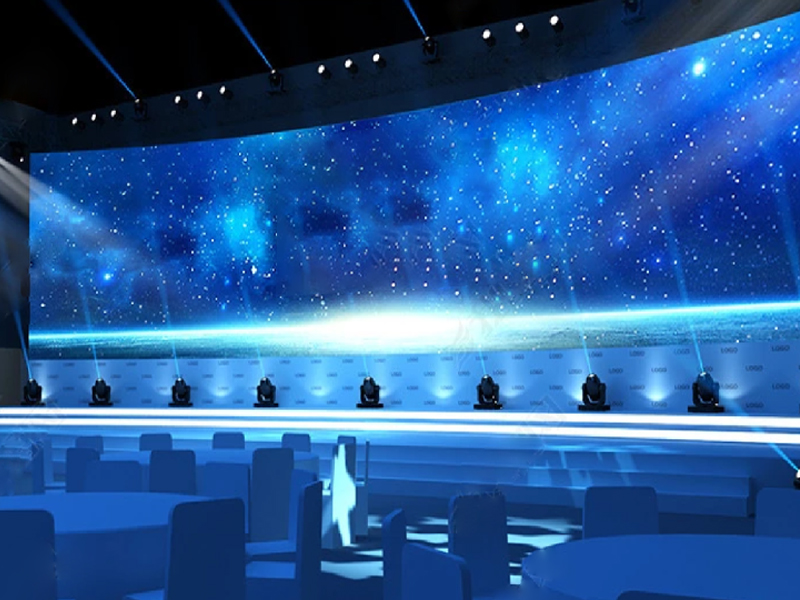
In asynchronous systems:
Content uploads through USB, network, or cloud platforms
The controller stores the media internally
The screen plays content independently without a continuously connected PC
USB drives
LAN networks
Wi-Fi
Cloud CMS platforms
Outdoor advertising
Storefront LED signs
Digital billboards
Transportation displays
This approach reduces operating costs and simplifies long-term content management.
Unlike LCD screens, LED displays do not use fixed native resolutions.
Instead, manufacturers build LED walls by combining modules into custom dimensions.
For example:
1920×1080 Input Signal
         ↓
 Video Processor Scaling/Cropping
         ↓
 Mapped to LED Screen Resolution
 (Example: 3840×2160 or custom resolution)
Because of this flexibility, LED processors must handle:
Scaling
Cropping
Pixel mapping
Multi-screen splicing
This capability allows LED displays to support both standard and non-standard resolutions.
Several technical specifications directly affect image quality and compatibility.
Parameter | Description |
Refresh Rate | Typically ≥60Hz; high-end screens may exceed 3840Hz |
Color Depth | 8-bit, 10-bit, or 12-bit color processing |
Color Space | RGB or YUV input conversion |
Frame Synchronization | Prevents tearing in multi-screen systems |
High refresh rates are especially important in:
Broadcast environments
XR virtual production
Live streaming
Film shooting
Low refresh rates can create:
Scan lines
Flickering
Rolling artifacts on camera
Therefore, professional LED displays often use refresh rates above 3840Hz.
Higher color depth allows smoother color transitions.
For example:
8-bit supports basic color rendering
10-bit improves gradients
12-bit delivers more accurate HDR performance
As HDR content becomes more common, high bit-depth processing grows increasingly important.
LED display input formats include much more than just HDMI or DVI connectors. A complete LED system combines:
Physical interfaces
Transmission protocols
Control architectures
Video processing technologies
The best input solution depends on factors such as:
Resolution requirements
Transmission distance
Real-time performance
Installation environment
Content type
For most modern projects, HDMI and DP dominate standard applications, while SDI, fiber optics, and network streaming serve professional and large-scale LED systems.
 +86 18688923792
  andy@tosled.com